
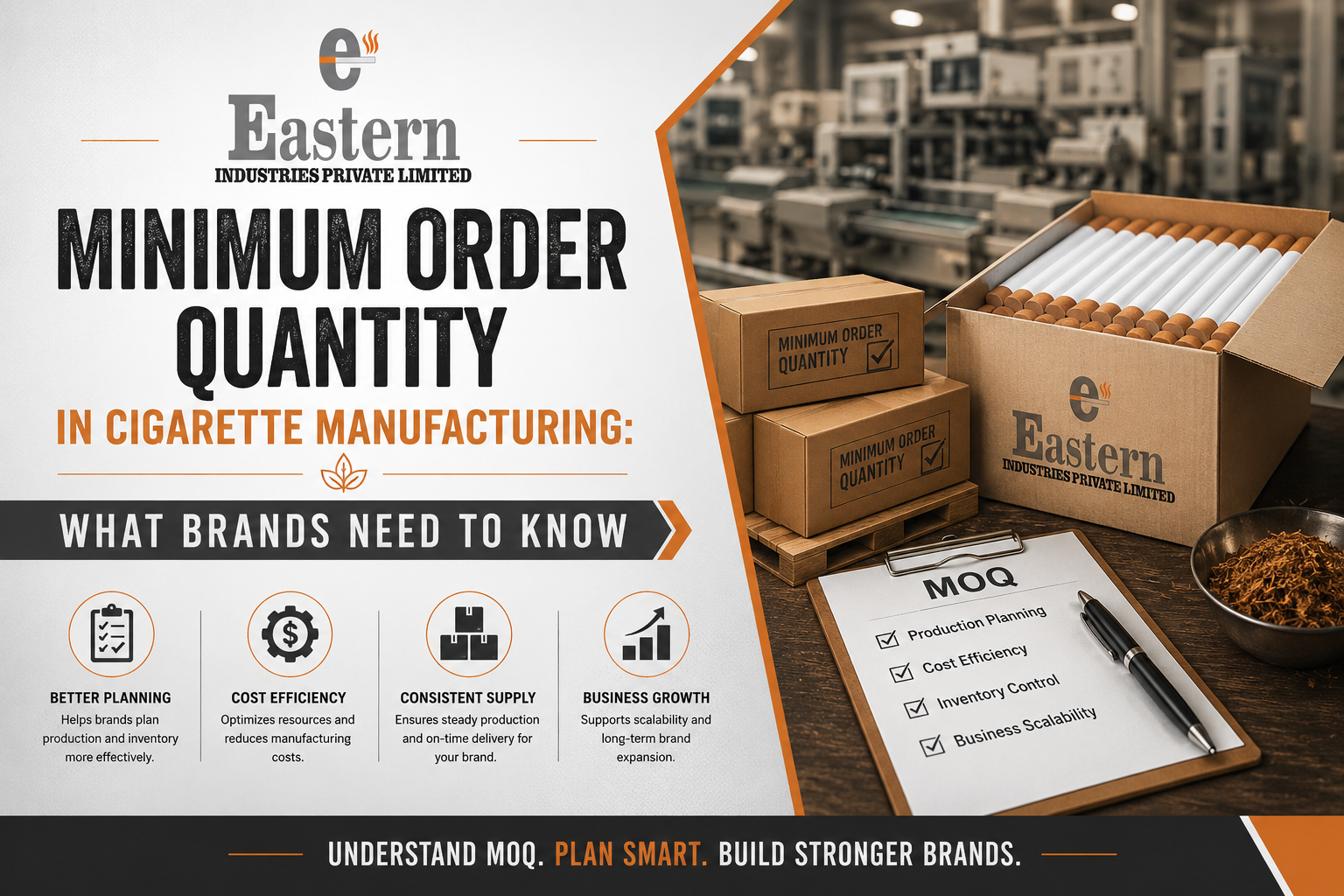
Minimum Order Quantity in Cigarette Manufacturing: What Brands Need to Know
Every conversation between a new brand and a cigarette manufacturer eventually lands on the same question. How much do we need to order? It sounds simple. In practice it is one of the most misunderstood parts of the entire procurement process. MOQ is not just a number a manufacturer pulls from a price list. It reflects machine setup costs, raw material procurement cycles, packaging lead times, and a dozen other variables that most brand owners have never had to think about before. Understanding how MOQ cigarette manufacturing actually works before you walk into that first supplier conversation saves a significant amount of time, money, and frustration on both sides of the table.
What is MOQ and Why Does It Exist?
MOQ stands for minimum order quantity. It is the smallest volume a manufacturer will produce in a single run and it exists for a straightforward commercial reason. Setting up a production line for cigarettes is not a small undertaking. Machinery has to be configured, calibrated, and cleaned between runs. Raw materials including tobacco, filter rods, cigarette paper, tipping paper, and packaging components have to be sourced and delivered in advance. A run that is too small to cover those setup costs is a run the manufacturer loses money on regardless of what they charge per unit.
The MOQ cigarette manufacturing threshold is essentially the point where a production run becomes commercially viable for the factory. Below that threshold, the economics simply do not work. Understanding that logic helps brand owners approach MOQ conversations more productively rather than treating the number as an arbitrary barrier the manufacturer invented to make life difficult.
What Factors Determine MOQ in Cigarette Production?
Machine Configuration and Setup Time
High-speed cigarette manufacturing equipment is built for volume. The setup process for a new run, loading the correct tobacco blend, calibrating fill weight, setting filter insertion parameters, configuring the packaging line for a specific box format, takes time and skilled labour regardless of whether the run is 500 cartons or 50,000. That fixed setup cost gets spread across every unit produced in the run. The smaller the run, the higher the per-unit cost of setup. This is why contract mfg minimum quantity thresholds tend to be higher for more complex product configurations like super slim formats or specialty packaging than for standard king size soft packs.
Raw Material Procurement
Tobacco manufacturers do not keep every possible tobacco grade, filter specification, and packaging component in stock at all times. For a custom order, particularly one involving private label packaging with unique artwork and dimensions, materials have to be ordered specifically for that run. Suppliers of those materials have their own minimum order requirements, and those requirements flow directly into the MOQ the cigarette manufacturer sets for the brand. A bulk cigarette order gives the manufacturer enough volume to justify sourcing custom components without the per-unit cost becoming unworkable.
Packaging Complexity
Standard packaging formats are faster and cheaper to run than custom configurations. A brand that wants a unique box shape, a specific foil finish, a smart seal feature, or a non-standard cigarette count per pack is adding complexity at every stage of the packaging line. That complexity has a cost and it typically shows up as a higher minimum order tobacco manufacturer threshold than a brand ordering a straightforward king size hard pack would face. The more custom the packaging, the more volume is needed to make it commercially sensible.
Typical MOQ Ranges in the Industry
MOQ in cigarette manufacturing varies considerably depending on the manufacturer, the market they serve, and the type of product being ordered. At the lower end, manufacturers who specifically serve emerging brands and market entry clients may work with runs starting from around 50,000 to 100,000 sticks. Mid-tier commercial runs typically start from 500,000 sticks upward. Large-scale export orders and established brand restocks regularly run into the tens of millions of sticks per order.
For brands entering the market through the contract manufacturing process, the first order tends to be the most expensive on a per-unit basis precisely because it is the smallest. As the brand grows volume and orders increase, the per-unit economics improve substantially. This is a normal and expected curve and manufacturers who work regularly with new brands understand it and price accordingly rather than penalising early-stage clients for ordering conservatively.
MOQ for Private Label vs Contract Manufacturing
These two routes to market have different MOQ dynamics and it is worth understanding the distinction before deciding which path fits the brand better.
With contract cigarette manufacturing, the brand owner typically supplies or specifies the blend, the format, and the packaging design, and the manufacturer produces to those specifications. The MOQ in this model reflects the full complexity of producing a custom product from the ground up, including sourcing specific materials and configuring the line for a unique output. It tends to sit higher than off-the-shelf alternatives because nothing in the production run is standard.
With a private label cigarette manufacturer, the brand owner is essentially putting their name and packaging on a product the manufacturer already knows how to produce. The tobacco blend is established, the format is standard, and the only truly custom element is the packaging artwork. MOQ in this model tends to be more accessible for new brands because the setup complexity is significantly lower. For brands that are testing a market or launching with limited capital, private labelling is often the more practical entry point before moving to fully custom contract manufacturing once volume justifies it.
How to Negotiate MOQ as a New Brand?
Walking into an MOQ conversation without preparation is one of the most common mistakes new brand owners make. A few things change that dynamic quickly.
Come with a realistic volume projection for the first twelve months. Manufacturers are more willing to work with lower initial MOQs when the brand owner can demonstrate a credible growth trajectory and the conversation is clearly about a long-term supply relationship rather than a one-off order. Nobody builds a production facility to run single orders for brands that disappear after the first shipment.
Be clear about packaging requirements upfront. Vague briefs lead to inflated MOQ estimates because the manufacturer has to build in contingency for unknowns. A brand that arrives with finalised artwork, confirmed dimensions, and a clear format specification gives the manufacturer everything they need to price precisely rather than conservatively.
Ask about tiered pricing rather than just MOQ. Many manufacturers will work below their standard cigarette MOQ Pakistan threshold for a first order if the per-unit price reflects the higher setup cost proportionally. This is a negotiable position in most supplier relationships and it is worth having that conversation directly rather than assuming the quoted MOQ is fixed.
Why Pakistan Is Becoming a Preferred MOQ-Friendly Manufacturing Hub?
For international brands looking to source from a manufacturer that can accommodate smaller initial runs without sacrificing quality, Pakistan has become an increasingly attractive option. The combination of lower labour costs, Export Free Zone manufacturing advantages in Karachi, and a maturing cigarette production infrastructure means that Pakistani manufacturers can offer competitive cigarette MOQ Pakistan thresholds that manufacturers in higher-cost origins simply cannot match without significantly higher per-unit pricing.
Pakistani manufacturers who have invested in high-speed machinery and consistent quality control are also able to scale with a brand as volume grows, which means the supplier relationship does not have to change as the brand moves from market entry volumes to commercial scale. That continuity has real value for a brand building long-term supply chain reliability into its operations from the start.
Conclusion
MOQ is not the obstacle it looks like from the outside. It is a commercial reality built on legitimate production economics, and understanding it properly turns what feels like a barrier into a straightforward negotiation. Know your volume projections, be specific about your product requirements, and choose a manufacturing partner whose MOQ structure reflects the kind of relationship they want to build with your brand. The right manufacturer is not the one with the lowest MOQ on paper. It is the one whose production standards, communication, and scalability match where your brand is going. That is the conversation worth having.