
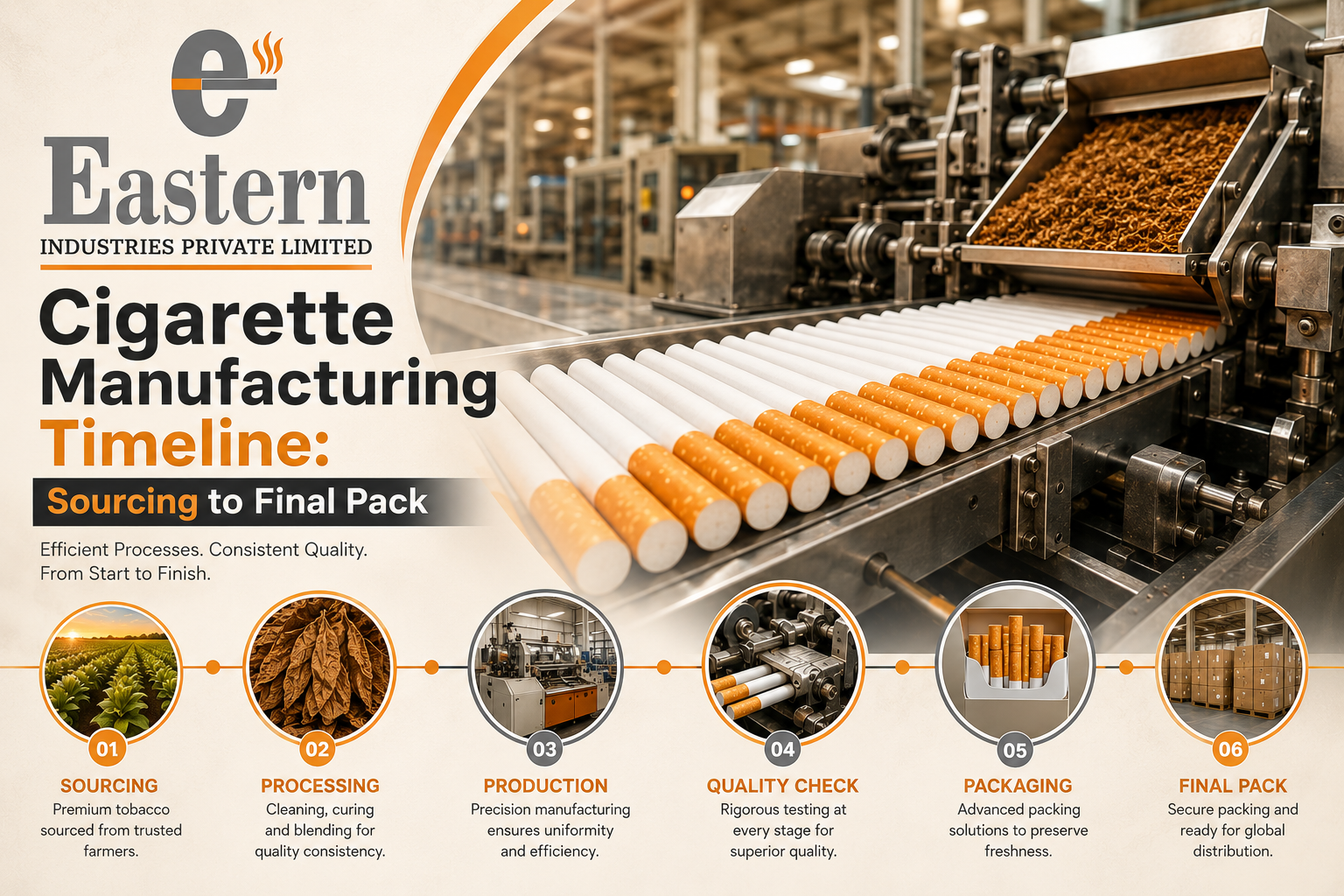
Cigarette Manufacturing Timeline: From Tobacco Sourcing to Final Pack
New brand owners almost always underestimate how long it actually takes to go from a product idea to a finished cigarette sitting in a carton ready for distribution. The assumption is that once the blend is agreed and the packaging is designed, the factory handles the rest quickly. The reality is that a cigarette has more production stages than most consumer products its size, and each stage has its own timeline, its own dependencies, and its own potential to add delays if it is not managed properly. Understanding the full cigarette production timeline before signing with a manufacturer is one of the most practical things a brand owner can do to avoid the kind of launch delays that cost real money.
Stage 1: Tobacco Sourcing and Procurement
Everything starts with the leaf. Before a single cigarette can be produced, the tobacco has to be sourced, inspected, and delivered to the manufacturing facility in a condition that meets the blend specification. For manufacturers who source directly from growers or primary processors, this stage involves evaluating crop availability, negotiating pricing against seasonal market conditions, and arranging logistics from the growing region to the factory.
The timeline here varies considerably depending on whether the manufacturer holds inventory or sources per order. A manufacturer with standing stock of commonly used grades can move through this stage in days. A manufacturer sourcing a specific grade to a buyer’s specification from a remote origin can take four to eight weeks just to get the leaf to the facility. Working with a reliable threshed tobacco supplier who maintains consistent inventory removes a significant portion of this uncertainty, particularly for brands that need predictable production lead times built into their supply chain planning.
The tobacco sourcing to pack journey begins here and the quality of decisions made at this first stage follows the product all the way to the final carton.
Stage 2: Leaf Processing and Conditioning
Raw leaf that arrives at the factory does not go straight into the blending room. It goes through a conditioning process first. Moisture levels are adjusted to bring the leaf within the target range for processing, typically between 12 and 14 percent. Leaf that arrives too dry has to be rehydrated carefully to avoid uneven moisture distribution. Leaf that arrives too moist has to be dried down without damaging the physical structure of the lamina.
For manufacturers receiving whole leaf bales, the threshing and separation process also happens at this stage if it has not been completed upstream. Threshing separates the lamina from the stem, and the quality of that separation directly affects the blend consistency in every batch that follows. This stage typically runs between three and seven days depending on the volume being processed and the condition of the incoming leaf.
Stage 3: Blending
Once the leaf is conditioned and processed, the blending operation begins. Different leaf grades and varieties are combined in the ratios specified by the blend recipe, and casing compounds are applied and allowed to absorb before the blend moves forward. This is one of the cigarette production steps timeline stages that demands the most precision and the most patience. Rushing the casing absorption produces an uneven flavour base that the top dressing applied later cannot fully correct.
Blending timelines vary based on batch size and recipe complexity. A straightforward two-variety blend for a standard king size product moves faster than a multi-variety recipe involving Oriental tobacco and custom casing compounds. Broadly, blending including casing and resting time runs between two and five days for most commercial batch sizes.
Stage 4: Cutting
The blended tobacco is fed through cutting machinery that reduces the leaf to the strip width specified for the product format. King size cigarettes use a different cut width than slim or super slim formats, and the cut consistency directly affects how the tobacco packs into the tube and how it burns once filled. This is a faster stage in the cigarette production timeline, typically completed within one to two days for a standard commercial batch, but it requires calibration checks throughout the run to ensure the cut specification holds without drifting.
Stage 5: Cigarette Making and Filter Attachment
This is where the tobacco becomes a cigarette. High-speed making machines feed cut tobacco into a continuous rod, wrap it in cigarette paper, and cut it to length before attaching the filter with tipping paper. On modern industrial equipment, this stage runs at speeds that can produce thousands of cigarettes per minute. The cigarette factory process at this stage is largely automated, but it requires consistent monitoring for fill weight, rod diameter, and filter attachment quality throughout the run.
Despite the speed of the machinery, this stage still takes time when factored against the full production volume. A run of 10 million sticks on a single making machine takes considerably longer than a run of 1 million. Lead time planning has to account for the actual machine hours required against the production schedule, not just the machine’s theoretical speed rating.
Stage 6: Packaging
Finished cigarettes move from the making machine into the packaging line where they are loaded into soft packs or hard packs, wrapped in foil and outer paper, banded, and cartoned. Custom packaging formats take longer to set up and run than standard configurations, and first-time production runs for a new brand always carry a longer setup time than repeat orders where the line has already been configured for that specific pack format.
Packaging is also where compliance requirements for the destination market come into the process. Health warnings, regulatory text, and barcode specifications all have to be present and correct before the product can be packed for export. Getting this wrong at the packaging stage means either reprinting packaging materials or holding finished product while corrections are arranged, both of which add time and cost to the overall cigarette production timeline.
Stage 7: Quality Control and Export Preparation
Before a shipment leaves the facility, finished product goes through quality control checks covering fill weight, physical appearance, pack integrity, and compliance documentation. This stage also involves preparing the export documentation package including the grade certificate, certificate of origin, packing list, and any destination-specific regulatory paperwork required for import clearance.
For brands working through contract cigarette manufacturing, this documentation stage is handled by the manufacturer on the brand’s behalf, which removes a significant administrative burden from brand owners who are managing multiple markets with different import requirements simultaneously.
Total Timeline: What to Realistically Expect
Adding all stages together, a first production run for a new brand with custom packaging typically runs between six and twelve weeks from leaf procurement through to finished cartons ready for shipment. Repeat orders for established brands with existing packaging and blend specifications run considerably faster, often between three and five weeks depending on volume and the manufacturer’s current production schedule.
The variables that most commonly extend timelines are packaging artwork approval delays, late changes to blend specifications, and sourcing complications for specific leaf grades. Brands that arrive with finalised specifications, approved artwork, and a clear volume commitment consistently see shorter lead times than brands that treat the production conversation as part of the product development process rather than a downstream execution step.
Understanding minimum order quantity requirements early in the planning process also affects timeline significantly. Brands that order at or above the manufacturer’s standard threshold move through the scheduling queue faster than brands requesting below-threshold runs that require special accommodation.
Conclusion
A cigarette is a simple product that takes a surprisingly involved journey to produce. From the leaf leaving the growing region to the finished pack being loaded into a container, every stage has its own requirements, its own timeline, and its own potential to either run smoothly or create delays that compound across everything that follows. Brands that understand the how long to manufacture cigarettes reality before they start the conversation with a manufacturer plan better, negotiate better, and launch on time more often than brands that treat production timelines as the manufacturer’s problem to manage. They are not. They are a shared responsibility, and the brands that treat them that way get better results.