
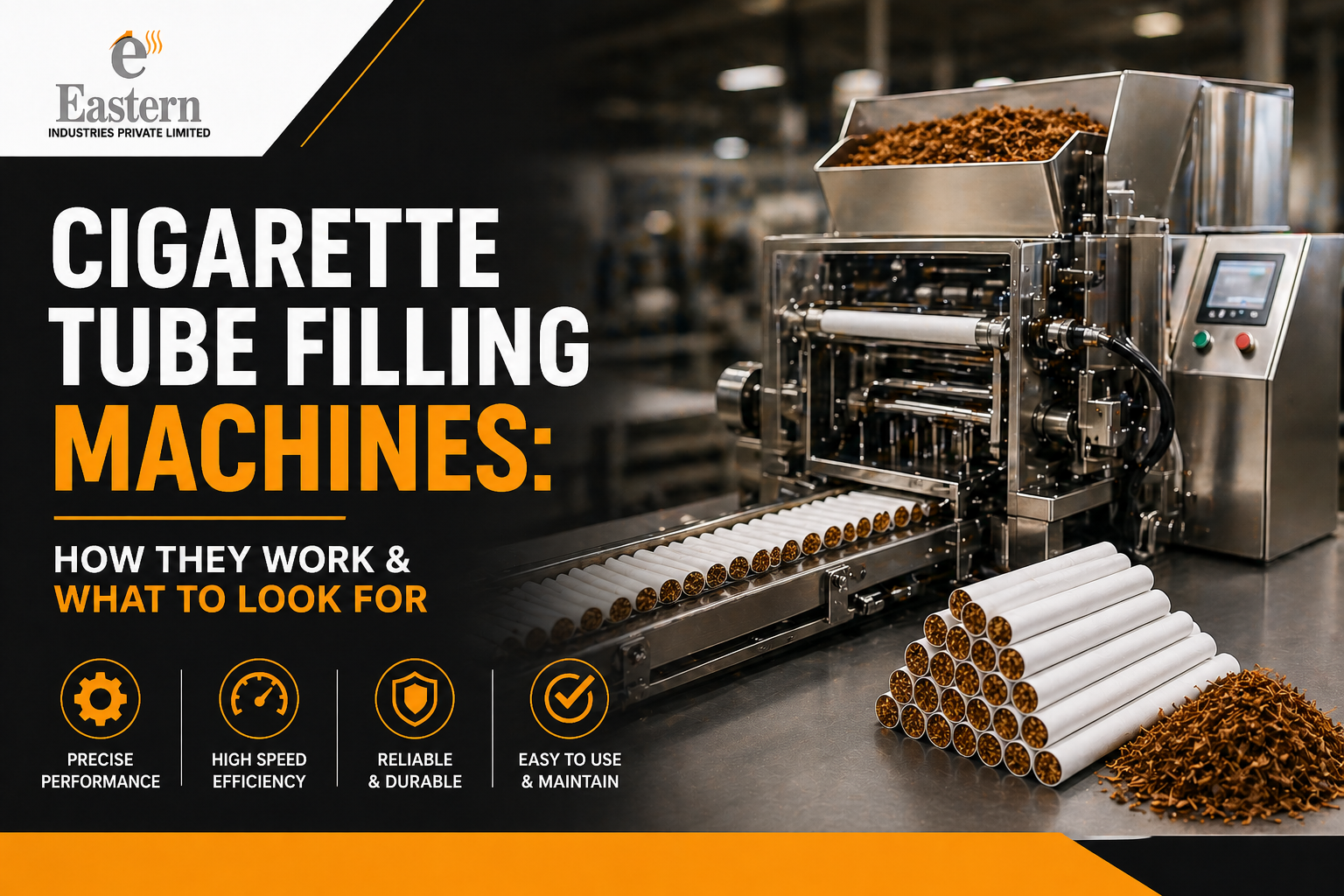
Cigarette Tube Filling Machines: How They Work & What to Look For
What separates a factory-made cigarette from a hand-filled one? Most people would say the tobacco blend or the brand behind it. The honest answer is compression. Uniform, consistent, repeatable compression on every single unit. That is what a cigarette tube filling machine actually delivers, and once you understand that, the rest of the buying decision becomes a lot clearer.
What is a Cigarette Tube Filling Machine?
At its core, a tube filling machine does one thing. It takes loose tobacco and packs it into a pre-made cigarette tube with enough consistency and compression that the finished product smokes like a factory-made cigarette. The tube already has the filter attached. The machine handles the fill. Done right, you get a cigarette that is uniform in draw, even in burn, and identical in weight from one unit to the next.
Where it gets interesting is in the range of machines available. From a simple handheld cigarette tube injector that fits in a kitchen drawer to a fully industrial unit capable of producing thousands of cigarettes per hour, the technology scales dramatically depending on what the user actually needs.
Types of Tube Filling Machines
Choosing the wrong type is the most common mistake buyers make. The price difference between categories can be significant, but so can the output difference. Here is how the three main categories break down.
Manual Injectors
A manual cigarette tube injector is the entry point. These are small, simple devices where the user loads tobacco into a chamber, inserts the tube over a nozzle, and pushes a lever or slider to inject the fill. They are cheap, portable, and require no power source. The tradeoff is that every cigarette depends on how consistently the user loads the chamber. Pack it light one time and heavy the next and the results will show. For personal use or very low volume, a manual injector does the job. For anything resembling a production environment, it becomes a bottleneck quickly.
Semi-Automatic Machines
Semi-automatic machines bring a motor into the process. The user still feeds tobacco and places tubes, but the compression and injection are handled mechanically. This removes the biggest variable in manual filling, which is human inconsistency, and the result is a noticeably more uniform cigarette across a batch. These machines sit in the middle of the market in terms of both price and output. Small tobacco retailers, hobby producers, and small-scale commercial operations tend to find this category the most practical. Output typically runs between a few hundred and a few thousand cigarettes per hour depending on the model.
Fully Automatic Industrial Machines
At the top end, a fully automatic cigarette tube filling machine operates with minimal human input. Tobacco feeds in, tubes load automatically, and finished cigarettes come out the other end at rates that can reach tens of thousands per hour on high-capacity units. These machines include sensors for fill weight, rejection systems for defective units, and integration options for packaging lines. The capital cost is substantial. The running cost per unit is not. For any operation producing at commercial scale, the economics of a fully automatic machine make everything else look inefficient by comparison.
Key Features to Look for When Buying a Filling Machine
The spec sheet for any filling machine will list a lot of numbers. Not all of them matter equally. These are the ones worth paying close attention to before signing anything.
Fill consistency is the single most important measure. A machine that produces cigarettes with varying tobacco density is worse in some ways than no machine at all, because the inconsistency is less obvious until the customer notices it. Ask for sample output and weigh it before committing.
Tube compatibility matters more than buyers expect. Not all machines handle all tube diameters equally well. King size, slim, and super slim tubes each have different dimensional tolerances, and a machine optimised for one format may perform poorly on another. If the product range includes multiple formats, confirm compatibility across all of them upfront.
Maintenance access is something that gets ignored during the buying process and becomes a serious issue six months later. Machines with accessible components, available spare parts, and clear service documentation cost less to run over time than machines that are cheaper to buy but difficult to maintain.
Speed ratings should always be read as theoretical maximums. Real-world output on most machines runs at 70 to 80 percent of the listed figure once loading time, minor adjustments, and cleaning cycles are factored in. Build that reality into the capacity planning from the start.
How Machine Quality Affects the Final Cigarette?
A cigarette that smokes well is the product of two things working together. The quality of the tobacco blend and the precision of the fill. Even a premium blend will disappoint if the fill is uneven. Too loose and the cigarette burns fast, draws easy, and delivers less than it should. Too tight and the draw becomes laboured, the burn slows unevenly, and the smoker notices something is off even if they cannot name what it is.
Good machines control compression through calibrated fill chambers and consistent injection pressure. The best ones allow for adjustment so that operators can tune the fill density to match the specific tobacco cut they are working with. A coarser cut needs different compression than a fine cut, and machines that offer that kind of control produce a noticeably better end result across different tobacco types.
Pairing the Right Tubes with the Right Machine
The machine is only half of the equation. The tubes it fills have to be built to a standard that the machine can work with reliably. Tubes with inconsistent paper weight, weak filter adhesion, or dimensional variation outside acceptable tolerances will cause jams, misfills, and rejected units regardless of how good the machine is.
This is why sourcing tubes and machine selection should happen together rather than separately. A machine calibrated for one tube specification will underperform with a different tube from a different supplier, even if both tubes look identical on the outside. The tolerances that matter are internal and only reveal themselves during production runs.
Eastern Tobacco’s High-Quality Cigarette Tubes
Eastern Tobacco manufactures cigarette tubes built to tight dimensional and paper weight specifications, which means they are designed to perform consistently across both semi-automatic and fully automatic filling environments. The tubes are available across multiple formats including king size, slim, and super slim, and the production standards are maintained to ensure that every batch performs the same way as the last.
For buyers sourcing tubes alongside a cigarette tube filling machine setup, Eastern Tobacco’s ability to supply consistent, high-specification tubes removes one of the most common variables that causes production problems downstream. The combination of reliable tubes and the right machine is where consistent output actually starts.
Conclusion
A filling machine is only as good as the consistency it delivers, and consistency depends on the machine, the tobacco, and the tubes all working together without friction. Whether the operation is small-scale or fully industrial, the principles do not change. Understand what the machine actually does, choose the type that matches the production volume, and pair it with tubes built to a standard the machine can handle reliably. Get those three things right and the quality of the finished cigarette takes care of itself.