
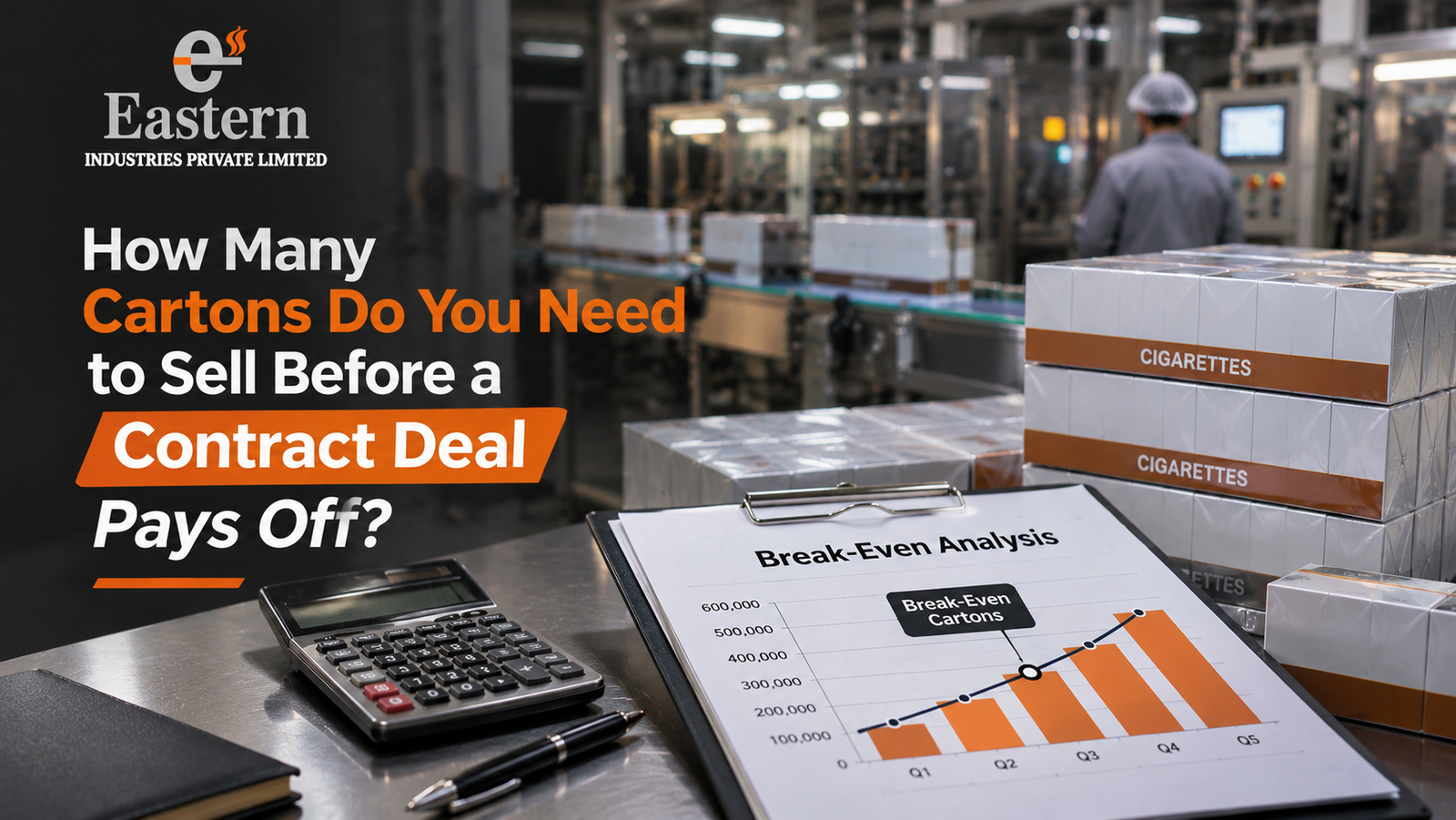
How Many Cartons Do You Need to Sell Before a Contract Deal Pays Off?
Entering a cigarette manufacturing agreement requires more than finding a manufacturer and agreeing on a production price. Brand owners need to understand how many cartons they must sell before recovering their initial investment and generating a profit. Calculating break even cartons contract manufacturing requirements helps businesses evaluate their financial commitments before production begins. From packaging expenses and manufacturing charges to distribution costs and applicable taxes, every expense influences the number of cartons needed to reach profitability. Understanding these figures early can prevent financial surprises and support better business decisions. If you are evaluating production arrangements, exploring Contract Manufacturing services can help you understand the cost structures and contractual responsibilities involved.
Understanding the Break-Even Point in Cigarette Production Agreements
The break-even point represents the sales volume at which a business has generated enough contribution from its products to cover its relevant fixed costs. In outsourced cigarette production, this means determining how many cartons must be sold before the brand owner recovers expenses associated with launching or operating the agreement.
The calculation depends on three important figures: total fixed costs, net revenue per carton, and variable cost per carton. Fixed costs remain relatively stable within the relevant production range, while variable costs increase as production and sales volumes grow. The difference between net revenue and variable costs is known as the contribution margin. Once the accumulated contribution margin covers fixed expenses, the business reaches break-even. However, achieving this point does not automatically mean the company has recovered every cash payment made during the production process.
What Costs Should You Consider Before Calculating Break-Even Cartons?
A reliable break-even calculation begins with identifying every relevant expense. Initial fixed costs may include packaging development, printing plates, product registration, regulatory approvals, production setup, and other contractual charges. Some expenses are incurred only once, while others must be recovered over a specific accounting period.
Variable costs generally include manufacturing charges, tobacco materials, filters, packaging components, transportation, and other expenses directly linked to each carton produced or sold. Applicable excise duties, taxes, and distribution charges also need careful treatment because they can significantly affect the amount retained from each sale.
Not every payment belongs in the same category. Recoverable taxes, refundable deposits, and inventory purchases may require different accounting treatment. Separating these expenses correctly allows brand owners to calculate a realistic contribution margin instead of relying solely on the manufacturer’s quoted production price.
How to Calculate Break-Even Cartons in an Outsourced Production Deal
The Break-Even Formula Explained
Calculating the required carton sales begins with dividing total fixed costs by the contribution margin earned on each carton. The standard formula is:
Break-Even Cartons = Total Fixed Costs ÷ (Net Revenue per Carton − Variable Cost per Carton)
Net revenue should reflect the amount the business actually earns after relevant discounts and deductions. Variable costs should include expenses directly associated with producing and selling each carton, without counting the same expense twice.
The resulting figure represents the number of cartons that must be sold to cover the defined fixed costs, assuming the selling price and cost per carton remain unchanged. If a calculation produces a fractional carton, the required sales volume must be rounded up to the next whole carton.
A Practical Example Using Carton Sales
Consider a hypothetical cigarette brand entering a manufacturing agreement with initial fixed costs of $30,000. Suppose the business earns $50 in net revenue per carton and incurs $35 in variable costs. This produces a contribution margin of $15 per carton.
Dividing $30,000 by $15 gives a break-even requirement of 2,000 cartons. At that sales volume, the total contribution reaches $30,000, covering the assumed fixed expenses.
If the brand sells 2,500 cartons under the same conditions, the additional 500 cartons generate $7,500 in contribution beyond the initial fixed-cost requirement. This amount represents operating profit within the simplified model, before any excluded costs, additional taxes, financing charges, or other expenses.
These figures are illustrative, not actual industry prices or quotations.
How Unit Economics Affect Your Cigarette Brand’s Profitability
Understanding unit economics contract manufacturing arrangements is essential because total sales revenue alone cannot determine whether a production agreement is financially sustainable. A brand may generate substantial revenue while retaining only a small contribution from each carton after manufacturing, taxation, and distribution expenses.
For example, if the contribution margin in the previous calculation decreases from $15 to $10 per carton while fixed costs remain $30,000, the break-even requirement increases from 2,000 to 3,000 cartons. Even a relatively small change in per-carton economics can therefore create a significant difference in the sales volume needed.
Brand owners should examine the sensitivity of their calculations to price reductions, higher material costs, distributor discounts, and freight increases. Evaluating several possible financial scenarios provides a more useful picture than relying on one optimistic sales projection.
What Determines the Profitability Threshold of a Cigarette Brand?
The profitability threshold cigarette brand owners need to evaluate depends on more than the manufacturing price. Market-specific taxes, legal compliance expenses, distribution arrangements, and the timing of sales can influence when an agreement begins generating an accounting profit.
One important factor is the difference between the manufacturer’s selling price and the brand owner’s realized revenue. Distributors and retailers may retain margins that reduce the amount received by the brand. Product returns, damaged inventory, and discounts can further affect realized revenue.
A meaningful profitability calculation must also consider the period being measured. A brand may recover its initial setup expenses while still facing ongoing administrative, warehousing, or contractual costs. Financial projections should therefore distinguish between recovering launch-related expenses and achieving sustainable profitability over successive production orders.
How Minimum Order Quantities Influence Your Break-Even Point
Minimum order quantities, commonly called MOQs, establish the smallest production volume a manufacturer is willing to accept under an agreement. These requirements may reflect production efficiency, raw material purchasing commitments, packaging specifications, and equipment setup costs.
However, a manufacturer’s minimum order quantity and the brand owner’s break-even sales volume are not necessarily equal. A contract requiring 5,000 cartons does not mean the brand becomes profitable after selling 5,000 cartons. Profitability still depends on actual revenue, variable costs, and the fixed expenses included in the calculation.
A larger order may reduce certain production costs per carton, but it can also increase the amount of cash tied up in inventory. Unsold cartons create storage obligations and financial exposure. This makes it important to evaluate manufacturing commitments alongside realistic sales forecasts rather than assuming larger production volumes automatically improve financial performance.
When Does a Cigarette Manufacturing Deal Become Profitable?
Understanding when a manufacturing deal becomes profitable requires distinguishing between completed production, recognized sales, accounting profit, and actual cash recovery. These events do not necessarily happen at the same time.
A manufacturer may require advance payment before production, while a distributor may receive several weeks or months to settle its invoices. In that situation, the brand could record sales sufficient to reach accounting break-even while still waiting to collect the corresponding cash.
Profitability also depends on how fixed costs are allocated. Initial artwork or packaging development expenses may benefit multiple production runs, whereas recurring administrative and regulatory costs continue throughout operations. Brand owners should establish whether their break-even analysis concerns the first order, a financial year, or the entire commercial agreement. Clear definitions make financial projections more meaningful and easier to compare.
Common Financial Mistakes That Delay Break-Even
One common mistake is calculating profitability using the manufacturer’s production price without including additional costs incurred before the cartons reach customers. Freight, handling, duties, distributor allowances, and other charges can reduce the actual contribution margin.
Another mistake involves treating every produced carton as a sold carton. Inventory that remains in storage does not automatically generate sales revenue, even though the manufacturer may already have received payment. Businesses can also underestimate the effect of delayed customer collections, unexpected production changes, and contractual penalties.
Overly optimistic pricing assumptions create another risk. A projected selling price may not reflect discounts or revised distribution terms. Instead of depending on a single sales forecast, brand owners should calculate break-even under conservative, expected, and favorable conditions. This approach highlights financial vulnerabilities before they become expensive commitments.
How to Evaluate a Manufacturing Agreement Before Committing
Before entering an agreement, brand owners should examine its pricing structure, minimum purchase requirements, payment schedule, cost-adjustment provisions, quality responsibilities, and termination conditions. Each provision can influence the financial obligations associated with production.
The manufacturing model itself also deserves consideration. Businesses comparing different arrangements can review OEM vs Contract Manufacturing for Cigarettes: Key Differences Every Brand Owner Must Know to better understand how production responsibilities, specifications, and commercial arrangements may differ.
A company evaluating Eastern Tobacco, for example, should assess the specific terms offered rather than assuming that any manufacturer follows a universal pricing or production model. Financial projections should be based on documented quotations, applicable regulatory requirements, and realistic customer payment expectations. This allows decision-makers to compare the complete cost of an agreement instead of focusing only on its quoted manufacturing rate.
Final Thoughts
Determining how many cartons must be sold before a manufacturing agreement pays off is fundamentally a question of contribution margin, fixed expenses, and achievable sales volume. The break-even formula provides a useful starting point, but its reliability depends on accurate cost estimates and realistic revenue assumptions.
A well-prepared financial assessment should consider the effect of taxes, distribution margins, minimum orders, unsold inventory, and payment delays. It should also distinguish accounting profitability from the recovery of invested cash.
For cigarette brand owners, the objective is not simply to secure a production agreement. It is to understand the financial obligations involved, establish measurable profitability expectations, and make contract decisions supported by a clear understanding of the numbers.