
How to Export Cigarettes from Pakistan: Licences, Documents and Logistics Step by Step
Pakistan has a well-established tobacco industry that goes back several decades. The country grows its own leaf, processes it at scale, and manufactures finished cigarettes that meet international quality standards. For foreign buyers and domestic manufacturers alike, Pakistan represents a genuinely competitive sourcing option, whether you are looking for finished cigarettes, cut rag, or threshed tobacco Pakistan processors can supply in bulk.
But getting product out of Pakistan and into another country is not as simple as finding a supplier and booking a container. The export process involves multiple regulatory bodies, a specific set of documents, and logistical decisions that affect cost, speed, and compliance. This guide walks through the entire process step by step, from the first licence application to the final FOB shipment.
Step 1: Understand Who Regulates Tobacco Exports in Pakistan
Before anything else, you need to know which government bodies are involved. Tobacco exports in Pakistan fall under the oversight of several authorities.
The Federal Board of Revenue (FBR) handles taxation and customs clearance. All exporters must be registered with FBR and hold a valid National Tax Number (NTN).
The Pakistan Tobacco Board (PTB), operating under the Ministry of National Food Security and Research, regulates the tobacco sector specifically. Any company intending to export raw tobacco or tobacco products needs to be registered with the PTB. This registration is separate from general export registration and is specific to the tobacco trade.
The Trade Development Authority of Pakistan (TDAP) does not issue licences but plays a role in export promotion and can be a useful resource for new exporters navigating the process.
For finished cigarettes specifically, the Federal Excise Duty (FED) framework also applies. Exported cigarettes are generally zero-rated for FED purposes, but the paperwork must reflect this correctly or the exporter risks complications at the clearance stage.
Step 2: Obtain the Required Licences
Getting your tobacco export licence Pakistan requires going through two parallel tracks: general export registration and sector-specific tobacco registration.
General Export Registration is handled through the FBR. You need an active NTN and, for companies, registration with the Securities and Exchange Commission of Pakistan (SECP). Once these are in place, you are eligible to export any permitted goods.
Pakistan Tobacco Board Registration is the sector-specific requirement. Exporters of tobacco leaf, cut rag, or manufactured tobacco products must register with the PTB. The registration process involves submitting company documents, details of the product you intend to export, your manufacturing or sourcing setup, and relevant tax registrations. The PTB may also require inspection of your facility before registration is confirmed.
It is worth noting that if you are a foreign buyer arranging export through a Pakistani manufacturer rather than exporting directly, the manufacturer holds these registrations on your behalf. This is a common arrangement, particularly in contract cigarette manufacturing Pakistan setups where the factory manages the full export process for the overseas client.
Step 3: Prepare Your Cigarette Export Documentation
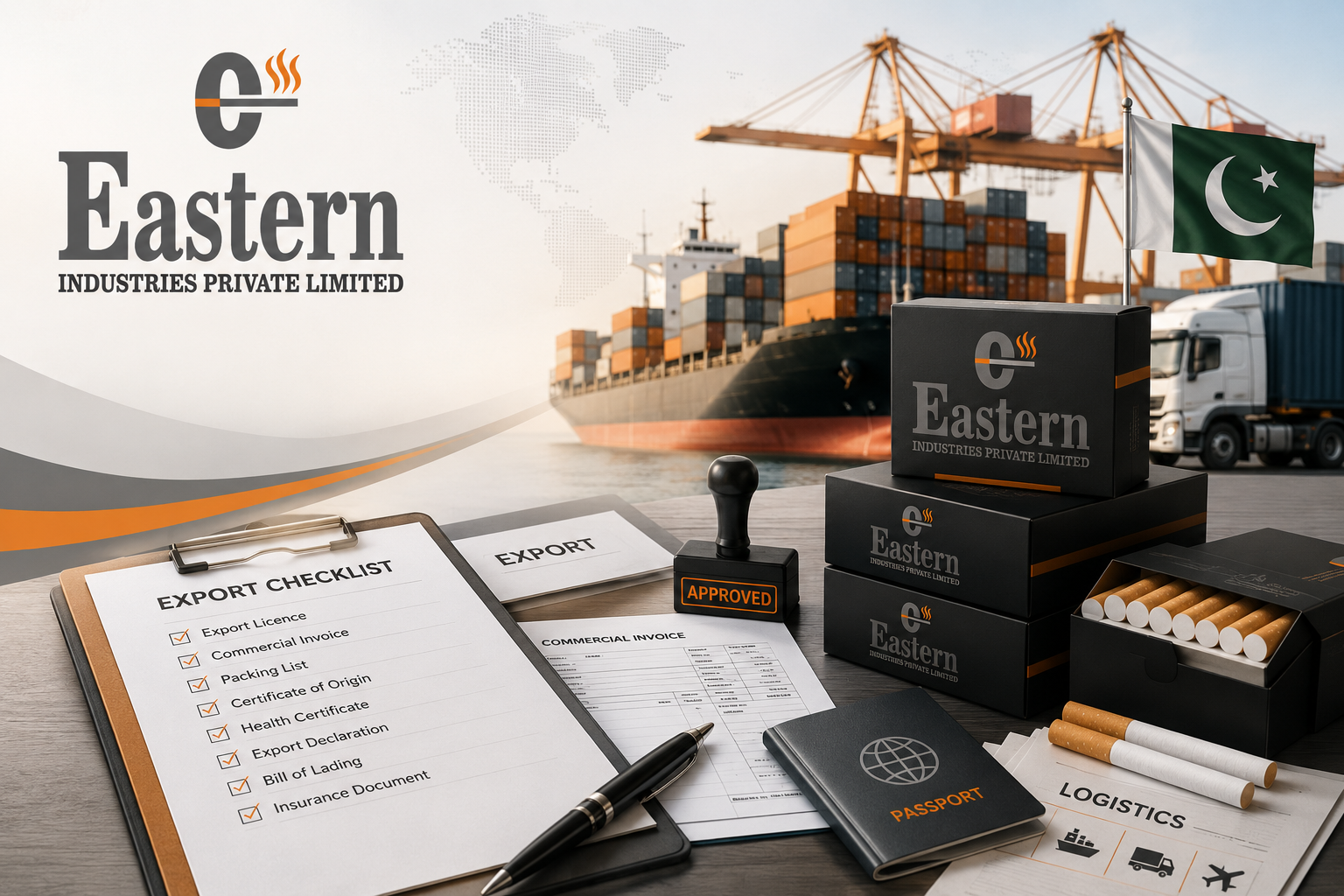
Once your licences are in place, the documentation stage begins. This is where many first-time exporters run into delays, usually because one document is missing, incorrectly completed, or not authenticated properly. The core documents required for cigarette export from Pakistan are as follows.
Commercial Invoice covers the full details of the transaction: buyer and seller information, product description, quantity, unit price, total value, currency, and terms of sale. For cigarettes, the invoice must also include the brand name, pack count, and HS code.
Packing List breaks down exactly what is in each carton, how many cartons make up the shipment, and the gross and net weights. Customs authorities use this alongside the invoice to verify the shipment.
Bill of Lading or Airway Bill is issued by the shipping carrier and serves as the title document for the goods. For sea freight, which is the standard mode for bulk cigarette exports, this will be a Bill of Lading.
Certificate of Origin is required by most destination countries to determine applicable tariffs. Pakistan has preferential trade agreements with a number of countries, and the correct certificate, issued by TDAP or the relevant chamber of commerce, can reduce the import duty the buyer pays at their end.
Pakistan Tobacco Board Export Permit is required for each shipment of tobacco products. This is not a one-time document. Every individual export consignment needs its own PTB permit, which confirms the product has been properly registered and is authorised for export.
Health Warning Compliance Certificate may be required depending on the destination country. Most markets now require specific health warnings on cigarette packaging, and some require a certification that the warnings meet local standards before the goods are cleared for import.
Phytosanitary Certificate applies primarily to raw tobacco leaf and threshed tobacco rather than finished cigarettes, but exporters dealing in both product types should be aware of this requirement.
Step 4: Understand Export Duty and Tax Treatment
A common question from new exporters is what export duty cigarettes Pakistan shipments attract. The short answer is that Pakistan generally does not impose an export duty on tobacco products. The government’s policy is oriented toward encouraging exports rather than taxing them.
However, the domestic Federal Excise Duty that applies to cigarettes sold inside Pakistan does not apply to exported goods. To claim zero-rating on FED for export shipments, the exporter must provide customs with proof that the goods have left Pakistan’s territory. This is typically done through the customs export declaration and the Bill of Lading, which together confirm physical export.
Sales tax treatment for exports follows a similar zero-rating principle, but again, the paperwork must be complete and accurate. Exporters who do not complete customs formalities correctly can find themselves in a dispute with FBR over domestic tax liability, even on goods that were genuinely exported.
Step 5: Logistics and Tobacco FOB Shipment
Most cigarette exports from Pakistan move on FOB (Free on Board) terms, meaning the seller delivers the goods to the named port and the buyer takes responsibility from that point. The main export gateway for sea freight is Karachi Port or Port Qasim, both of which have established container handling infrastructure.
For a tobacco FOB shipment, the exporter is responsible for packing, inland transport to the port, customs clearance at origin, and loading onto the vessel. The buyer arranges freight insurance and the ocean carrier from the port of origin onward.
Packing for cigarette exports requires attention to climate and transit conditions. Cigarettes are moisture-sensitive, and a shipment that arrives with damaged packaging or compromised product due to poor packing will create claims and damage the commercial relationship. Cartons should be palletised, shrink-wrapped, and placed in sealed containers. Reefer containers are sometimes used for longer voyages or shipments to humid climates.
Lead time from order confirmation to FOB ready typically runs four to eight weeks for manufactured cigarettes, depending on order volume, customisation requirements, and the manufacturer’s current production schedule.
Step 6: Vetting Your Supply Chain Before You Ship
Before committing to an export programme, it pays to do proper due diligence on every party in the chain. For buyers sourcing from Pakistan, this means running a proper tobacco supplier checklist before finalising any supplier relationship. Licence verification, factory inspection, product sampling, and reference checks are all standard practice in serious B2B tobacco procurement.
For Pakistani exporters, it means understanding your buyer’s regulatory environment. Cigarette import rules vary significantly by country. Some markets require pre-shipment approval of packaging. Others restrict nicotine levels, mandate specific warning formats, or prohibit certain additives. Exporting without this knowledge leads to shipments held at destination customs or returned at the exporter’s cost.
How Eastern Tobacco Handles the Export Process?
Eastern Tobacco has been exporting tobacco products from Pakistan for over two decades. The company is fully registered with the PTB, FBR, and SECP, and manages the complete export documentation process for international clients. From blend development and manufacturing through to customs clearance and FOB handover at Karachi, the entire chain is handled in-house.
For buyers who want a straightforward path into the Pakistan tobacco export market without building their own compliance infrastructure from scratch, working with an established manufacturer is the most practical route. The licences are in place, the documentation processes are established, and the logistics relationships are already built.
Conclusion
Exporting cigarettes from Pakistan is a manageable process when you understand what is required at each stage. The licence structure is clear, the documentation is standard, and the logistics infrastructure at Karachi is well-developed for containerised tobacco shipments. The complications that tend to arise come from incomplete paperwork, misunderstanding of the PTB permit requirement, or insufficient knowledge of the destination country’s import rules.
Getting these details right from the start saves time, avoids costly delays, and builds the kind of reliable supply chain that keeps buyers coming back.