
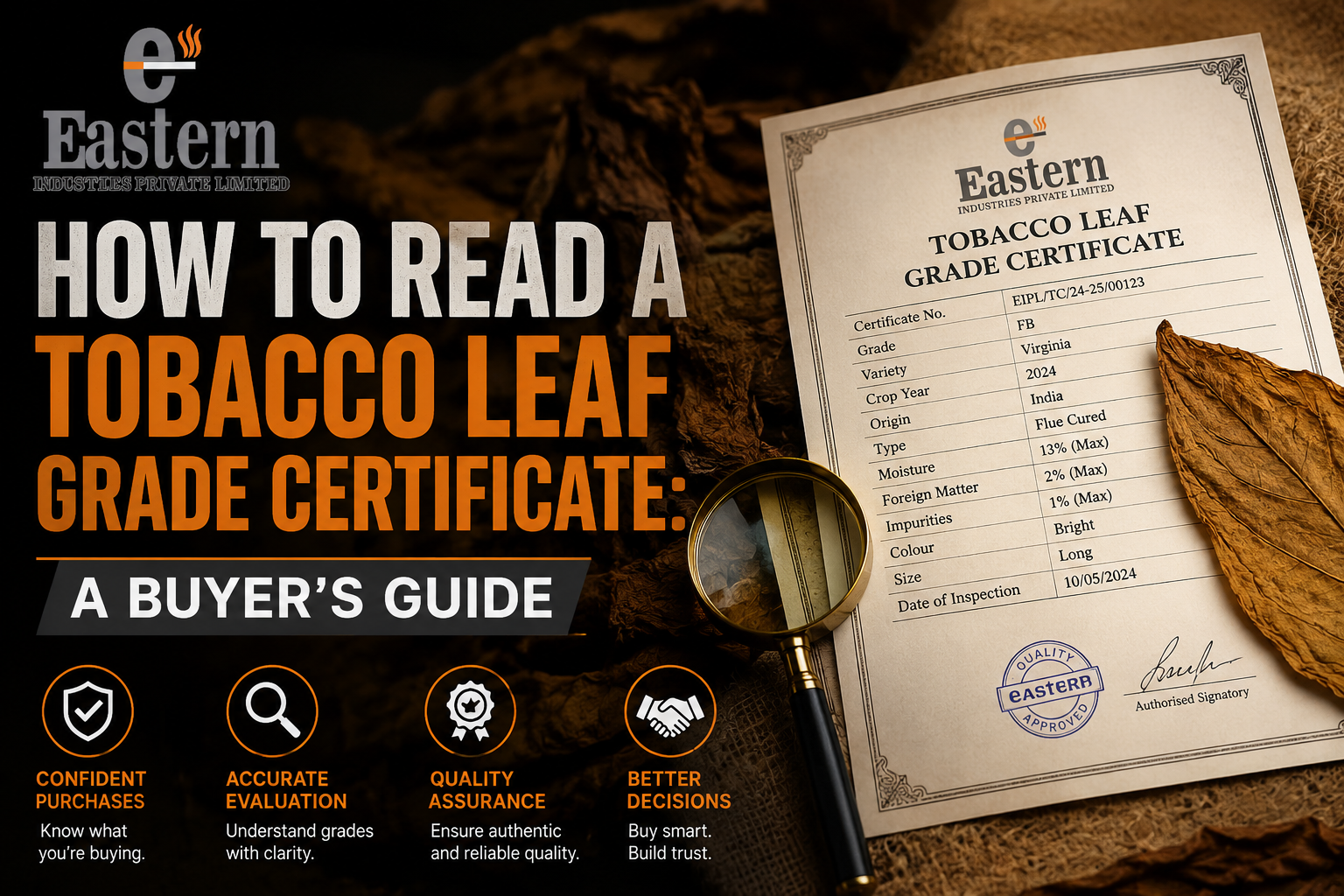
How to Read a Tobacco Leaf Grade Certificate: A Buyer's Guide
Most buyers know to ask for documentation when sourcing tobacco. Not all of them know what to do with it once it arrives. A tobacco quality certificate lands in the inbox, runs to several pages, and carries a dense mix of abbreviations, numerical ranges, and classification codes that mean very little without context. Nodding along and filing it away is one approach. Actually understanding what it says, and more importantly what it does not say, is a different skill entirely and one that separates buyers who get consistent product from buyers who spend time arguing over shipments that did not match expectations.
Why Grade Certificates Exist?
A tobacco leaf grade certificate is a formal record of the quality characteristics of a specific batch of leaf at the point of inspection. It exists because tobacco is an agricultural product with natural variability. No two harvests are identical. No two fields produce the same leaf even when planted with the same seed in the same season. The certificate is how a supplier communicates exactly what they are selling and how a buyer confirms that what arrived matches what was ordered.
In international trade, the tobacco quality certificate also functions as part of the tobacco import documentation package that clears customs in the destination country. Without it, or with one that contains errors or omissions, shipments get held. Clearance delays on perishable agricultural cargo are not a minor inconvenience. They are a direct financial cost and in some markets they create compliance records that affect future import approvals.
What a Tobacco Grade Certificate Actually Contains
The structure of a grade certificate varies slightly between suppliers and certifying bodies but the core information is consistent across most international formats. Understanding each section is what turns a document from a formality into a useful procurement tool.
Leaf Type and Origin
The certificate will identify the tobacco variety, flue-cured Virginia, Burley, Oriental, or another type, alongside the country and region of origin. This matters because the same grade classification can describe quite different product depending on origin. A buyer sourcing flue cured tobacco types from Pakistan will find that the leaf characteristics, even within the same grade classification, differ from the same grade sourced from Zimbabwe or Brazil. The origin field is not background information. It is context that shapes how every other figure on the certificate should be read.
Grade Classification
Tobacco grade classification systems use a combination of letters and numbers to describe where the leaf sits within a quality hierarchy. The exact coding varies by origin country and sometimes by individual supplier, but the underlying logic is consistent. Letters typically indicate leaf position on the plant, with lower leaf, mid leaf, and upper leaf carrying different combustion and flavour characteristics. Numbers or additional letters indicate quality within that position, covering colour uniformity, body, and freedom from damage or contamination.
Buyers who understand the tobacco grade classification system for the specific origin they are sourcing from can read the grade code and immediately form an accurate picture of what the leaf should look and smoke like before they ever open the bale. Buyers who do not understand the system are dependent entirely on the supplier’s description, which is a much weaker position to negotiate from
.
Moisture Content
Moisture is listed as a percentage and it is one of the most practically important figures on the certificate. The acceptable range for most commercial tobacco shipments sits between 10 and 14 percent depending on the leaf type and the destination market. Leaf arriving below 10 percent is brittle, prone to breakage during handling, and will lose further moisture in transit to a level where it becomes commercially unusable without reconditioning. Leaf arriving above 14 percent carries mold risk, particularly over long sea freight journeys in containers where temperature and humidity fluctuate.
The moisture figure on the certificate reflects the condition at the point of inspection, not at the point of delivery. Smart buyers factor in the expected transit conditions and seasonal temperature ranges for the shipping route when evaluating whether the certified moisture level will hold within acceptable limits by the time the shipment arrives.
Lamina to Stem Ratio
For buyers sourcing threshed leaf, the lamina to stem ratio is a critical figure. Lamina is the usable leaf material. Stem is the woody midrib that has been separated during threshing but may still be present in residual quantities in the batch. A high stem content reduces the effective yield per kilogram and increases the processing burden before the leaf enters the blending operation. The certificate should specify the lamina percentage clearly, and any figure below 85 percent lamina content warrants a direct conversation with the supplier before the shipment is accepted.
Understanding threshed tobacco grades in the context of lamina ratio is particularly relevant for buyers purchasing processed leaf rather than whole leaf bales. The threshing quality directly determines how much of what was paid for is actually usable, and the certificate is the only document that makes that calculation possible before the shipment is opened.
Leaf Quality Inspection Details
Leaf quality inspection results cover a range of physical characteristics that affect both the processing yield and the final smoke profile. Colour uniformity indicates how consistently the curing process was managed across the batch. Body describes the physical weight and density of the leaf, which affects how it cuts and how it performs under compression in a filling operation. Freedom from damage covers physical defects including insect damage, mold spots, mechanical tears from harvesting, and discolouration from improper curing or storage.
Each of these characteristics has a direct downstream consequence. A batch with poor colour uniformity will produce inconsistent combustion behaviour in the blend. A batch with significant physical damage will have a lower usable yield than the gross weight suggests. A batch with body below specification will perform differently under filling machine compression than the blend recipe was calibrated for. The inspection section of the certificate is where those risks either get flagged or get buried, and reading it carefully is the difference between catching a problem before it enters production and discovering it halfway through a run.
Red Flags to Watch for in a Certificate
Certain patterns in a grade certificate deserve immediate follow-up rather than acceptance. Moisture readings at the outer edge of the acceptable range, either very low or approaching the upper limit, suggest the batch was borderline at inspection and may have moved outside tolerance by delivery. Grade classifications that do not match the price being charged are worth questioning in both directions. Underpriced premium grade claims and overpriced mid-grade descriptions both indicate a mismatch between the document and the commercial reality.
Missing fields are another signal.
A certificate that omits lamina ratio, inspection date, or certifying body details is incomplete regardless of how professional it looks. Reputable suppliers providing high-quality threshed tobacco do not submit incomplete documentation because their reputation depends on transparency at every stage of the transaction. Incomplete paperwork from a new supplier is a reason to ask questions before committing to volume, not after.
How Eastern Tobacco Handles Grade Documentation
Eastern Tobacco provides full grade documentation alongside every threshed tobacco shipment, with certificates covering leaf type, origin, moisture content, lamina ratio, and leaf quality inspection results in a format aligned with international trade requirements. The tobacco quality certificate issued with each shipment reflects the actual batch condition at the time of inspection rather than a generic product description, which means buyers receive documentation they can use for both procurement decisions and import clearance without needing to request supplements or corrections after the fact.
For buyers who want to understand more about the leaf types covered by Eastern Tobacco’s documentation, the detail on tobacco import documentation requirements and grading standards connects directly to the leaf origin and variety information covered in the certificates they issue.
Conclusion
A grade certificate is only useful if the buyer reading it knows what they are looking at. The moisture figure, the lamina ratio, the grade classification code, the inspection details, none of those numbers exist in isolation. They tell a connected story about a specific batch of leaf and whether it matches what was ordered, what was paid for, and what the production line needs to perform consistently. Buyers who learn to read that story fluently make better sourcing decisions, catch problems earlier, and build supplier relationships on a foundation of verified performance rather than assumed trust. That foundation is what consistent product quality is actually built on.