
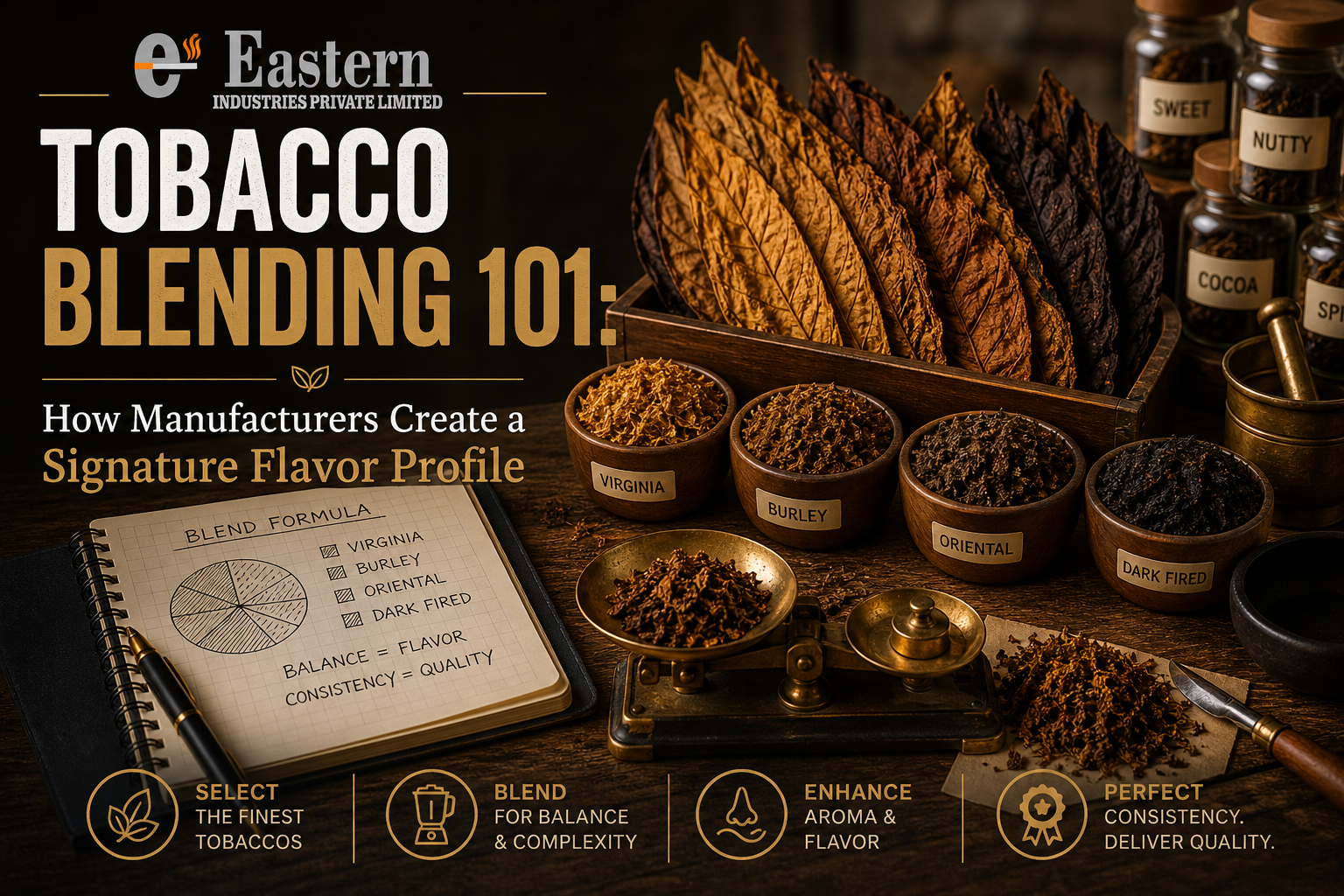
Tobacco Blending 101: How Manufacturers Create a Signature Flavor Profile
Pick up two cigarettes from different brands. Same country of origin, same leaf variety on the label. Light both. They will taste nothing alike. That gap is not marketing. It is not the filter or the paper doing something clever. It lives entirely in what happened to the tobacco before it was ever rolled. The tobacco blending process is where a cigarette finds its character, and most people who smoke every day have never given it a second thought.
What is Tobacco Blending?
At its simplest, blending is the act of combining different leaf varieties in calculated ratios to produce something that no single leaf could deliver on its own. Some leaves burn too hot. Some carry nicotine but very little taste. Some have a beautiful aroma but fall apart structurally the moment they are cut. The job of a blender is to take all of those individual weaknesses and build them into a finished cigarette flavor blend where each leaf is covering for the shortcomings of another.
What makes it genuinely difficult is that the ratios are not the whole story. The cut matters. The order of conditioning matters. The temperature and humidity during mixing matter. Shift any one of those and the result changes, sometimes in ways the average smoker would notice immediately and sometimes in ways that only reveal themselves slowly across a full pack.
Types of Tobacco Used in Blending
Most commercial cigarettes are built around three leaf types. Each one has a distinct role and experienced blenders treat them less like ingredients and more like instruments in the same piece of music.
Virginia / Flue-Cured Tobacco
Virginia is the starting point for the majority of international cigarette blends. It is flue-cured, dried with controlled indirect heat, and that process gives it a naturally light sweetness that makes it easy to work with as a base. It burns evenly, accepts flavour additions without fighting them, and sits gently on the throat. Blends that lean heavily on Virginia tend to produce something clean and approachable. There is a reason most of the world’s best-selling cigarette brands use it as their foundation.
Burley Tobacco
Burley is air-cured and it shows. Drier than Virginia, lower in natural sugars, heavier in character. What makes it irreplaceable in blending is how well it absorbs. Casing compounds and flavour agents soak into Burley better than almost any other leaf, which is exactly why manufacturers reach for it when they want to engineer a specific taste profile into the cigarette beyond what the raw leaf delivers. It also brings nicotine weight to the blend. A higher Burley ratio almost always means a fuller, more assertive smoke. At Eastern Tobacco, this same principle guides how we handle our threshed tobacco ensuring the leaf enters the blend at exactly the right moisture and cut for maximum absorption.
Oriental Tobacco
Oriental tobacco is the smallest contributor by volume but it punches far above its weight. Sun-cured and grown across Turkey, Greece, and parts of the Middle East, it carries a spicy, aromatic complexity that neither Virginia nor Burley comes close to replicating. Even a small percentage in a blend changes how the cigarette smells when lit, how the smoke moves in the air, and the overall impression it leaves. It is the detail that separates a flat, forgettable smoke from something that actually stays with you.
The Role of Casing and Top Dressing in Flavor Development
Leaf selection gets most of the attention but casing and top dressing are where a manufacturer really starts to build something distinct. These are two separate stages and they serve different purposes.
Casing comes first. A water-based solution carrying sugars, humectants, and base flavour agents is applied to the tobacco early in the process and given time to absorb fully. It conditions the leaf, improves how it handles through the production line, and lays a foundational flavour base before anything else happens. Top dressing is a later application, after the tobacco has been cut, and it is aimed directly at the aromatic side of the cigarette flavor blend. Menthol, cocoa, vanilla, and proprietary compounds go in here. This is what gives a cigarette that first recognisable hit of scent when the pack is opened and the immediate flavour impression on the first draw. For brands looking to develop a truly distinctive profile, this is precisely where our private label cigarette manufacturing process begins, with casing and top dressing built to your exact specification.
How Humidity and Moisture Levels Affect the Blend?
Tobacco absorbs and releases moisture constantly. Leave a pouch open overnight and you will feel the difference in the morning. That sensitivity to humidity is not just a storage concern. It runs through every stage of the blending operation and has a direct effect on how the finished cigarette performs.
Too dry and the tobacco becomes brittle. It burns fast, runs hot, and delivers a harsh throat hit that no amount of good leaf selection recovers from. Too moist and the burn becomes uneven, the filter gets overwhelmed, and the smoke loses definition. The target range for most finished blends sits between 12 and 14 percent moisture. Holding that range consistently from blending through cutting through packaging requires real environmental control across the entire production floor. A blend that performs perfectly in the factory can arrive at retail in a completely different condition if moisture management slips anywhere along the way.
Why Consistency in Blending Matters for a Brand?
A smoker who has been buying the same brand for years is not just buying a cigarette. They are buying the same experience they had the first time it worked for them. The moment that experience shifts, even slightly, they notice. Not always consciously. But the feeling is there. Something is different. And in tobacco, different is rarely welcome.
This is why blend ratios and processing parameters are treated as closely guarded intellectual property by serious manufacturers. The recipe is not just a formula written on a production sheet. It is the brand. Lose consistency in blending and you lose the one thing that keeps a customer coming back without thinking about it. Everything else in the production process exists to protect that.
Eastern Tobacco’s Approach to Premium Blend Creation
Eastern Tobacco sources its leaf exclusively from Pakistani-grown tobacco. That is a deliberate decision, not a default one. Pakistani tobacco from the Khyber Pakhtunkhwa region has a natural character that performs well across both full-bodied and lighter blend profiles, and controlling the source means controlling the starting point of every blend that comes out of the facility.
The production setup runs on high-speed machinery calibrated to hold consistent ratios across large runs, and moisture management is built into the process at every stage rather than monitored as an afterthought. For brands and businesses that need a reliable production partner, our contract manufacturing services are built around exactly this kind of repeatability, the same result on the tenth order as it did on the first. In a business where repeat orders are the only measure that really matters, that kind of repeatability is worth more than any single production run ever shows on paper.
Conclusion
The cigarette in your hand was decided long before it was rolled. The leaf choices, the ratios, the casing, the moisture levels, all of it happens during blending, and all of it shows up in how the finished cigarette smokes. For manufacturers who take quality seriously, the blending room is not just one part of production. It is where the product either earns its reputation or quietly loses it. Everything that follows is just carrying out the decision that was already made.