
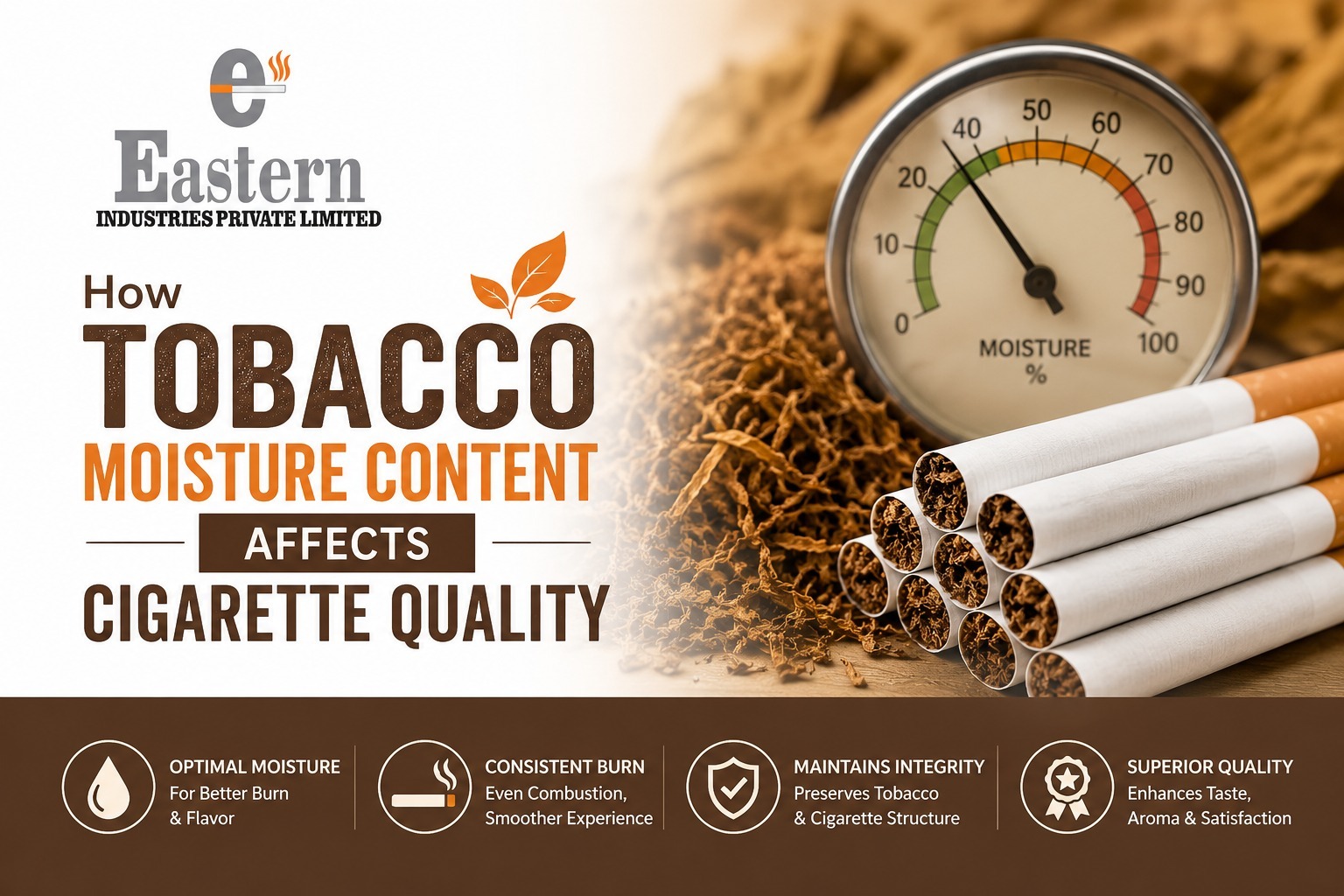
How Tobacco Moisture Content Affects Cigarette Quality
There is a variable in cigarette manufacturing that does not get nearly enough attention relative to how much damage it causes when it goes wrong. It is not the blend. It is not the filter. It is not even the packaging. It is moisture. The tobacco moisture content cigarette relationship is one of the most direct quality determinants in the entire production chain, and yet it is consistently underestimated by buyers and brand owners who focus on leaf variety and blend ratios while treating moisture as a background technical detail someone else manages. Nobody who has received a shipment of tobacco that arrived outside its moisture specification, or watched a production run produce inconsistent cigarettes because the cut tobacco was too dry, makes that mistake twice.
Why Moisture Levels Matter More Than Most People Think
Tobacco is hygroscopic. That single characteristic means it is constantly absorbing and releasing moisture from the surrounding environment. Leave a bale in a humid warehouse and it gains weight and moisture without anyone touching it. Store it in a dry environment and it loses moisture, becomes brittle, and starts breaking down physically before it ever reaches the production line. That responsiveness to ambient conditions is not a defect in the material. It is a fundamental property of the leaf that has to be actively managed at every stage from post-harvest curing through storage, transit, processing, and all the way to the finished pack sitting in retail.
The reason tobacco moisture content cigarette quality is so tightly connected comes down to what moisture actually does inside the tobacco structure. At the right level it keeps the leaf pliable, supports even combustion, carries flavour compounds effectively, and allows the cut tobacco to pack consistently into the cigarette rod. Shift it in either direction and multiple things start going wrong simultaneously, which is what makes moisture one of the harder quality variables to troubleshoot when problems appear downstream.
What Happens When Tobacco Is Too Dry
Dry tobacco is brittle tobacco. When cut tobacco drops below around 10 percent moisture content, the leaf fibres lose the flexibility that allows them to compress evenly inside a cigarette rod. The cut breaks rather than bends, producing excessive fine particles and dust that create uneven pack density along the length of the cigarette. That uneven density is the direct cause of one of the most common complaints about cigarette quality, which is a burn that runs faster down one side than the other.
The moisture effect cigarette burn at the dry end of the spectrum also shows up as a harsher smoke character. Dry tobacco burns hotter than properly conditioned tobacco because there is less moisture to absorb heat energy during combustion. The smoker experiences this as increased throat irritation and a smoke that tastes sharper and less rounded than the same blend would produce at the correct moisture level. None of that harshness comes from the blend itself. It comes entirely from the moisture being wrong.
On the production line, dry tobacco creates additional problems beyond the finished cigarette quality. It generates more dust during cutting and filling, which increases machine maintenance requirements and creates more frequent cleaning cycles. It also causes higher tobacco loss through breakage during handling, which affects the yield calculation for the production run and adds cost that does not show up in the original material pricing.
What Happens When Tobacco Is Too Moist
The problems at the high moisture end are different but equally damaging. Tobacco above 14 percent moisture content becomes sticky and clumps during cutting, which prevents the cut from being uniform and causes feed inconsistencies on the making machine. The tobacco rod that comes out of an overly moist fill is denser in some sections and looser in others, producing a cigarette that draws inconsistently from one puff to the next.
The burn behaviour changes too. Moist tobacco burns slower and produces more steam alongside smoke, which dilutes the flavour intensity and creates a heavier, wetter smoke character that most consumers find unsatisfying. The optimal moisture cigarette tobacco range exists precisely because both extremes produce a noticeably worse smoking experience, and the window between them is narrower than many people outside manufacturing realise.
Storage risk is the other major concern at high moisture levels. Tobacco stored or shipped above the acceptable moisture range creates conditions where mold can develop, particularly inside tightly packed bales where airflow is limited. Mold damage is not recoverable. A contaminated batch has to be written off entirely, and the contamination risk extends to adjacent bales in the same storage environment if it is not caught and isolated quickly.
The Optimal Moisture Range and How It Is Maintained
The target optimal moisture cigarette tobacco range for most commercial production sits between 12 and 14 percent at the point of processing. Some manufacturers work to a tighter internal specification of 12.5 to 13.5 percent for blend consistency purposes. Getting to that range and holding it requires active management rather than passive monitoring.
The tobacco drying process is one side of that management. Leaf that arrives too moist is passed through controlled drying equipment that reduces moisture levels gradually using temperature and airflow rather than aggressive heat that would damage the leaf structure. The gradual approach matters because rapid drying creates uneven moisture distribution, where the outer surface of the leaf dries faster than the interior, which produces a leaf that tests within range on a surface reading but still contains excess moisture deeper in the structure.
Rehydration is the other side. Leaf arriving too dry goes through a conditioning process where moisture is reintroduced in a controlled environment and allowed to equilibrate through the leaf before processing begins. Rushing this stage produces the same uneven distribution problem as aggressive drying, just in the opposite direction. Both processes require time and monitoring that cannot be shortcut without affecting the quality of everything that follows.
Humidity Control in Storage and Transit
Humidity tobacco storage is where moisture management either gets protected or undone after all the conditioning work is complete. Tobacco that leaves the processing facility at the correct moisture level can arrive at its destination outside that range if the storage and transit conditions are not controlled. Temperature swings in shipping containers, warehouse environments without humidity regulation, and extended transit times through multiple climate zones all create opportunities for moisture to drift in either direction.
Responsible manufacturers seal processed tobacco in moisture-barrier packaging before it leaves the facility and specify storage conditions clearly in their documentation. Buyers who store incoming tobacco in uncontrolled environments and then process it weeks or months later without checking current moisture levels are introducing a variable into their production that was not present when the material was shipped. It is a common source of production inconsistency that gets misattributed to leaf quality or blend issues when the actual cause is storage management.
Understanding the different tobacco leaf types also matters in this context because different varieties have different moisture absorption characteristics. Flue-cured Virginia absorbs and releases moisture at a different rate than air-cured Burley, and a blend containing both requires moisture management that accounts for how each component will behave under the same storage conditions rather than treating the blend as a single uniform material.
How Eastern Tobacco Manages Moisture Through Processing
Eastern Tobacco monitors moisture at multiple points through its processing operation rather than checking once at intake and assuming the level holds through the rest of the production stages. Incoming leaf is tested on arrival, adjusted during conditioning if needed, and checked again before cutting and blending to ensure the material entering the production line is within specification rather than assumed to be.
For buyers sourcing processed leaf, the threshed tobacco leaf processing at Eastern Tobacco includes moisture conditioning as a standard part of the operation rather than an optional step. Leaf that leaves the facility has been processed and conditioned to a moisture specification that is documented in the accompanying grade certificate, which gives buyers a verified starting point rather than an estimate when they receive the shipment.
Conclusion
Moisture is not a background variable in cigarette manufacturing. It is an active quality determinant that shapes how the tobacco cuts, how it fills, how it burns, and how the finished cigarette tastes. The tobacco moisture content cigarette connection runs through every stage of production and every stage of the supply chain, and the brands and manufacturers who manage it actively rather than reactively produce more consistent product with fewer production problems and fewer quality complaints from the market. Getting moisture right does not guarantee a great cigarette. But getting it wrong almost guarantees a bad one.