
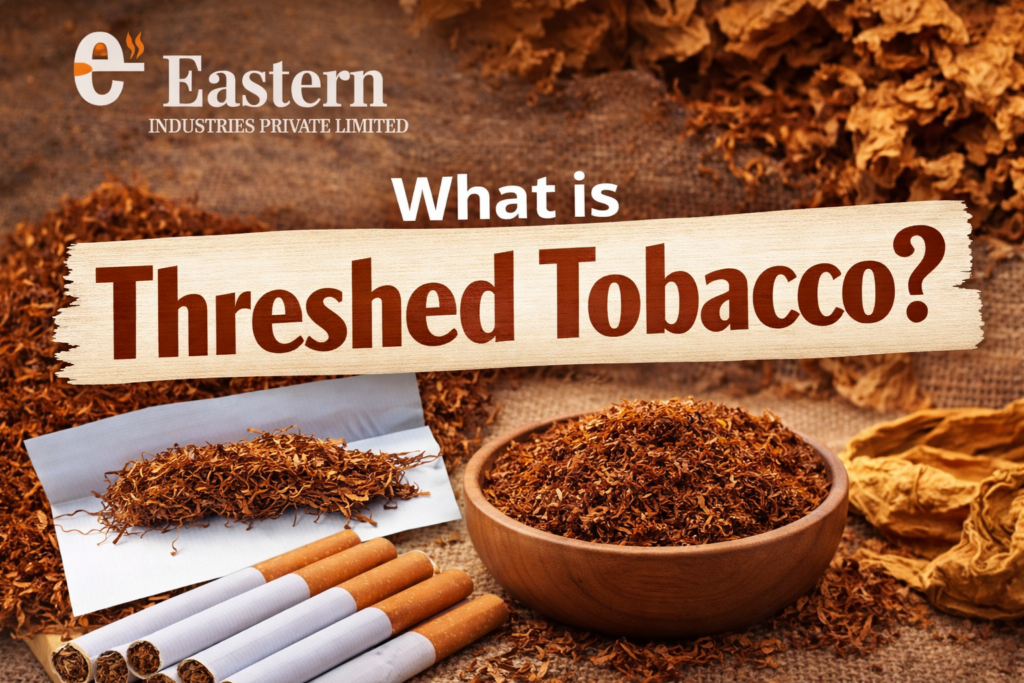
What is Threshed Tobacco? Processing, Grades & Global Demand Explained
Have you ever wondered why two cigarettes from different brands can feel entirely different in your hand but use the same type of tobacco leaf? The answer is not the blend. It is not the filter either. It starts at a stage most people have never heard of called threshing.
So, this guide covers what threshing is and what threshed tobacco processing actually involves, how it works from start to finish, what the different grades mean in practice, and why global manufacturers are paying closer attention to their lamina suppliers than ever before.
What Does Threshed Tobacco Mean?
At its simplest, threshed tobacco is tobacco leaf with the central stem removed. That central stem, known as the midrib, runs the full length of every tobacco leaf and it has no place in a quality cigarette. It is woody, burns unevenly, and contributes a harsh character to the smoke that no blending technique can cover up once it is already in the mix.
Strip the stem away and what remains is the lamina. Soft, flexible, aromatic, and far better suited to the cutting and blending stages that follow. The lamina is what actually ends up in the finished product. Threshing is the act of separating these two things cleanly, at scale, with enough precision that the lamina comes out intact and ready to work with.
The Threshing Process Step by Step
Good threshed tobacco processing is never a single action. It is a sequence of stages that build on each other, and the quality of the finished lamina is only as strong as the weakest point in that sequence.
Leaf Conditioning
Before any mechanical work begins, the leaf has to be conditioned first. Raw dried tobacco is brittle. Run it through processing equipment in that state and a large portion of the lamina crumbles to dust before threshing has even properly started. Conditioning uses controlled steam or fine water mist to bring moisture content up to somewhere between 16 and 22 percent. At that level the leaf becomes flexible and cooperative. Too dry and it shatters. Too wet and it clumps together and refuses to separate cleanly. Getting that balance right depends as much on an experienced operator reading the leaf by hand as it does on the machine settings.
Separation of Lamina from Stem
This is the stage that defines the whole operation. Conditioned leaves pass through threshing machines built around rotating drums, pins, and beaters that physically break the lamina away from the stem. One pass is almost never enough. Multiple passes are required, and after each one the material moves through pneumatic separators and classifiers that sort everything by size and weight, pulling stem fragments well away from usable lamina. The stems are not wasted. They typically feed into reconstituted sheet production or cut rag blends where structural filler serves a purpose. For premium lamina, they have no place whatsoever.
Drying and Cooling
After separation, the lamina holds more moisture than is suitable for storage or long-distance shipping. Rotary drum dryers bring it down to a stable range of around 10 to 13 percent. Drop below that and the leaf becomes too fragile to handle. Stay above it and mold or fermentation can develop inside the bales during transit. After drying, the material cools slowly and evenly because rushing that stage causes condensation to form inside the packed cases, quietly undoing everything the drying just achieved. The finished product then goes into moisture-lined bales ready to ship anywhere in the world.
Different Grades of Threshed Tobacco
Anyone sourcing leaf commercially needs a solid grasp of threshed tobacco grades because the differences between them are far from cosmetic. Grades are shaped by leaf variety, growing region, position on the stalk, and the physical condition of the lamina once threshing is complete.
Upper stalk leaves are lighter, thinner, and carry more aromatic character. Lower stalk leaves are heavier and produce a fuller, more robust profile suited to different blend applications. Top-grade threshed tobacco shows large intact lamina pieces with consistent color and zero stem contamination. Mid-grades carry more breakage and work well in blended or reconstituted formats. For premium cigarette manufacturing, only the upper grades make sense.
Who Buys Threshed Tobacco? Global Market Overview
The buyers span almost every region. Major cigarette manufacturers in Europe, the Middle East, Southeast Asia, and sub-Saharan Africa all purchase threshed tobacco as a core raw material. Most of this trade runs through long-term supply agreements rather than spot buying, because a manufacturer working with a consistent blend cannot afford unpredictable leaf quality from one year to the next.
The roll-your-own market in countries like Russia, Germany, and the Philippines has added a significant new demand layer for quality loose lamina. Across Africa, particularly in Nigeria, Kenya, and Uganda, the appetite for high-volume cigarette production keeps the wholesale threshed tobacco market active and competitive. As more manufacturing capacity shifts toward Asia and Africa, the demand for well-processed lamina from reliable sources is only heading in one direction.
Why Quality Threshing Matters for Final Cigarette Taste?
When stems end up in a blend, the result is not subtle. They burn hotter and produce a woody, acrid note that settles at the back of the throat. They also disrupt draw resistance in ways that are difficult to correct once the cigarette is rolling off the production line. No flavoring adjustment fixes stem contamination after the fact.
Clean threshing gives blenders a consistent and predictable starting point. When lamina quality holds steady from batch to batch, the finished cigarette tastes the same every time. That consistency builds real brand loyalty over time. Smokers may have no idea what threshed tobacco grades are or what the processing involves, but they notice immediately when something upstream has been handled carelessly.
Eastern Tobacco’s Threshed Tobacco Supply
Eastern Tobacco sources premium leaf from Pakistan’s finest growing regions and manages every aspect of threshed tobacco processing at its own facility inside the Export Free Zone in Karachi. Conditioning, separation, and drying are all handled in-house, giving the company full control over quality at every stage rather than depending on outside processors with their own priorities.
The company ships to manufacturers across the UAE, Egypt, Nigeria, Kenya, Malaysia, the Philippines, Russia, and many other countries, managing export logistics directly. Buyers working with Eastern Tobacco get complete supply chain transparency, reliable grade delivery, and a direct relationship with the actual processor rather than a middleman who has never seen the leaf up close.
Conclusion
Threshed tobacco holds the entire industry together without ever getting the recognition it deserves. The processing demands precision, the grading decisions carry consequences that appear much later in the finished product, and global demand for quality lamina is only gaining momentum. For manufacturers who understand that everything starts with the leaf, choosing the right supplier is not a secondary decision. It is the first one that genuinely shapes everything that comes after it. Eastern Tobacco has built its entire operation around getting that decision right for every client, every single time.