
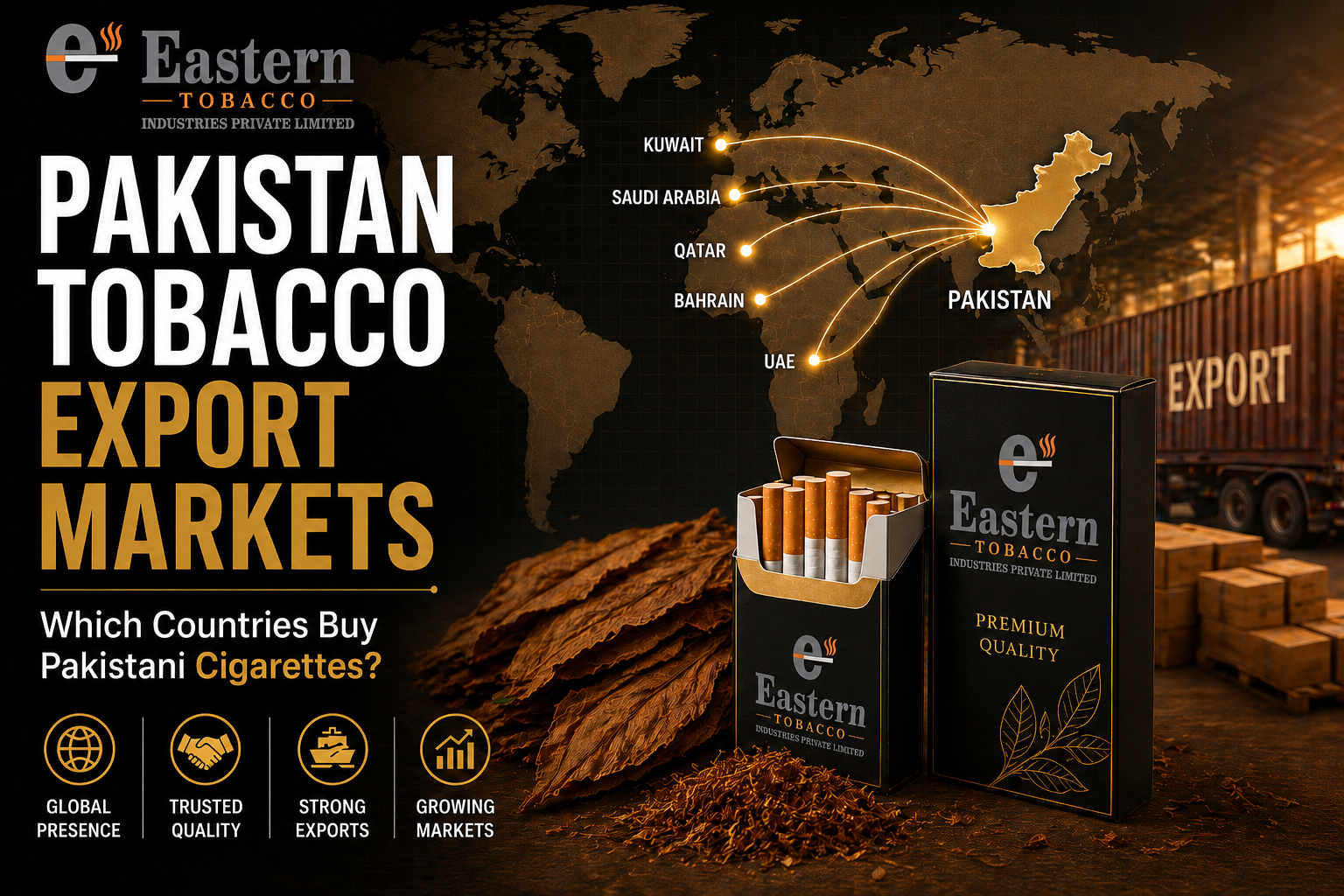
Pakistan Tobacco Export Markets: Which Countries Buy Pakistani Cigarettes?
Nobody talks about Pakistan when the conversation turns to global tobacco. Brazil gets the headlines. Zimbabwe gets the sourcing contracts. The United States built an entire cultural identity around its leaf. But quietly, without much fanfare, Pakistani tobacco has been filling containers bound for the Gulf, East Africa, and Southeast Asia for decades. The buyers who know it never look elsewhere. The ones who have not discovered it yet are still overpaying somewhere else.
Overview of Pakistan’s Tobacco Export Sector
Pakistan has been growing tobacco for well over a century, with the bulk of cultivation concentrated in Khyber Pakhtunkhwa. The leaf that comes out of this region, particularly Virginia and air-cured varieties, has built a quiet but solid reputation among international buyers who know their raw materials. What makes Pakistan genuinely competitive is not just the quality of the leaf. It is the combination of low production costs, an established processing infrastructure, and manufacturers operating out of Export Free Zones in Karachi where duty and tax structures make export pricing highly attractive.
Tobacco export Pakistan volumes have grown steadily over the past decade as more global buyers look to diversify their supply chains away from traditional sourcing countries. Pakistan offers something few regions can match at this price point, which is consistent leaf quality at scale.
Top Export Destinations for Pakistani Tobacco
Pakistani tobacco moves across multiple continents. The demand is not concentrated in one region. It spans the Middle East, Africa, and Southeast Asia, each market buying for different reasons and with different priorities.
Middle East (UAE, Saudi Arabia, Oman, Kuwait)
The Gulf region is one of the most active destinations for Pakistan cigarette export countries networks. The UAE in particular functions as both a direct consumer market and a re-export hub, with Pakistani cigarettes entering Jebel Ali and then moving onward to other markets across the region. Saudi Arabia, Oman, and Kuwait all represent steady demand, driven by large expatriate populations with established brand preferences and a retail environment that accommodates both premium and value-tier products. Logistics from Karachi to Gulf ports are well-developed and transit times are short, which makes the supply chain practical for buyers who need reliable replenishment cycles.
African Markets (Malawi, Madagascar, Libya)
Africa is an underestimated destination in conversations about Pakistani tobacco. Libya is a consistent buyer, with trade routed through established North African distribution channels. Kenya, Nigeria, and Uganda have also absorbed Pakistani cigarette volumes, particularly in markets where locally manufactured alternatives are limited or where a specific product format like soft pack or slim cigarettes fills a gap that domestic producers have not addressed. Mombasa functions as a regional port entry point for East African distribution, making it a practical hub for reaching multiple countries through a single logistics route. The price competitiveness of Pakistani tobacco gives it a real advantage in African markets where purchasing power shapes buying decisions at the wholesale level.
South and Southeast Asia (Malaysia, Thailand)
Malaysia and the Philippines have both been active in sourcing Pakistani tobacco, particularly for contract manufacturing arrangements where a local brand wants leaf or finished product that meets specific quality benchmarks without building their own processing capacity. Vietnam also sources from Pakistan at the trade level. These markets tend to be more specification-driven than volume-driven, meaning buyers arrive with detailed requirements around moisture content, strip grade, and cut specification. Pakistani processors who can meet those specs consistently tend to build long-term relationships with Southeast Asian buyers rather than one-off transactions.
Why International Buyers Choose Pakistani Tobacco?
The honest answer is value without compromise. Pakistani-grown tobacco, when processed properly, delivers a combustion profile and nicotine yield that competes with far more expensive sourcing options. Buyers who have tested both consistently report that the gap in quality between Pakistani leaf and premium sources from other regions is smaller than the gap in price.
Beyond the leaf itself, buyers appreciate the flexibility that Pakistani manufacturers offer. Whether a client needs soft pack and hard pack options, threshed leaf for their own blending, or finished private label product ready for retail, the same manufacturer can often handle the full scope. That flexibility reduces the number of vendor relationships a buyer has to manage, which matters operationally more than most buyers admit in early negotiations.
Export Free Zone status is another genuine advantage. Manufacturers operating within these zones pass on real cost benefits at the invoice level, and the regulatory framework for export documentation is streamlined compared to standard commercial zones.
Challenges in Tobacco Export from Pakistan
It would not be a fair picture without acknowledging the friction points. International banking and payment processing remains complicated for Pakistani exporters, particularly when dealing with buyers in regions where correspondent banking relationships are thin. Letters of credit and advance payment structures are common precisely because the financial infrastructure does not always support simpler settlement methods.
Regulatory compliance across destination markets is another layer that adds complexity. Each country a Pakistani cigarette enters has its own labelling requirements, health warning formats, and import documentation standards. A shipment that clears Karachi customs cleanly can still face delays at the destination port if the packaging does not match the importing country’s current regulatory template. Experienced exporters build this compliance work into their production process rather than treating it as an afterthought, which is one of the clearest ways to separate reliable suppliers from unreliable ones.
Currency volatility also plays into pricing conversations. Buyers on long-term contracts have to factor exchange rate movement into their cost modelling, and Pakistani suppliers who can offer USD-denominated pricing give their buyers more predictability to work with.
How Eastern Tobacco Supports Global Buyers?
Eastern Tobacco operates from the Export Free Zone in Karachi, which means every export that leaves their facility carries the cost and documentation advantages that zone status provides. The company supplies to buyers across the Middle East, Africa, South America, and Southeast Asia, and the range of what they can offer a single buyer is broader than most manufacturers at this scale.
For buyers who want finished product, Eastern Tobacco produces its own brands and handles contract manufacturing for private label clients who want their own name on the box. For buyers who want to handle their own blending and rolling, threshed leaf is available in consistent grades with clear specifications. The high-speed machinery the facility runs means large orders do not create lead time problems, which is something volume buyers test early and remember when they come back.
As a cigarette manufacturer in Pakistan with direct export infrastructure, Eastern Tobacco removes several steps that buyers would otherwise have to manage through intermediaries. The sourcing, processing, packaging, and export documentation all sit under one roof, which simplifies the supply chain at every stage.
Conclusion
Pakistan’s position in the global tobacco trade is stronger than its public profile suggests. The leaf quality is there, the processing infrastructure is there, and the pricing makes a genuine commercial case for buyers across multiple continents. The countries buying Pakistani cigarettes today span from Gulf capitals to African port cities to Southeast Asian manufacturing hubs, and the diversity of that buyer base is itself a signal of how far tobacco export Pakistan capabilities have developed. For buyers ready to explore a supply relationship built on consistency, flexibility, and real export expertise, Eastern Tobacco is the place to start that conversation.