
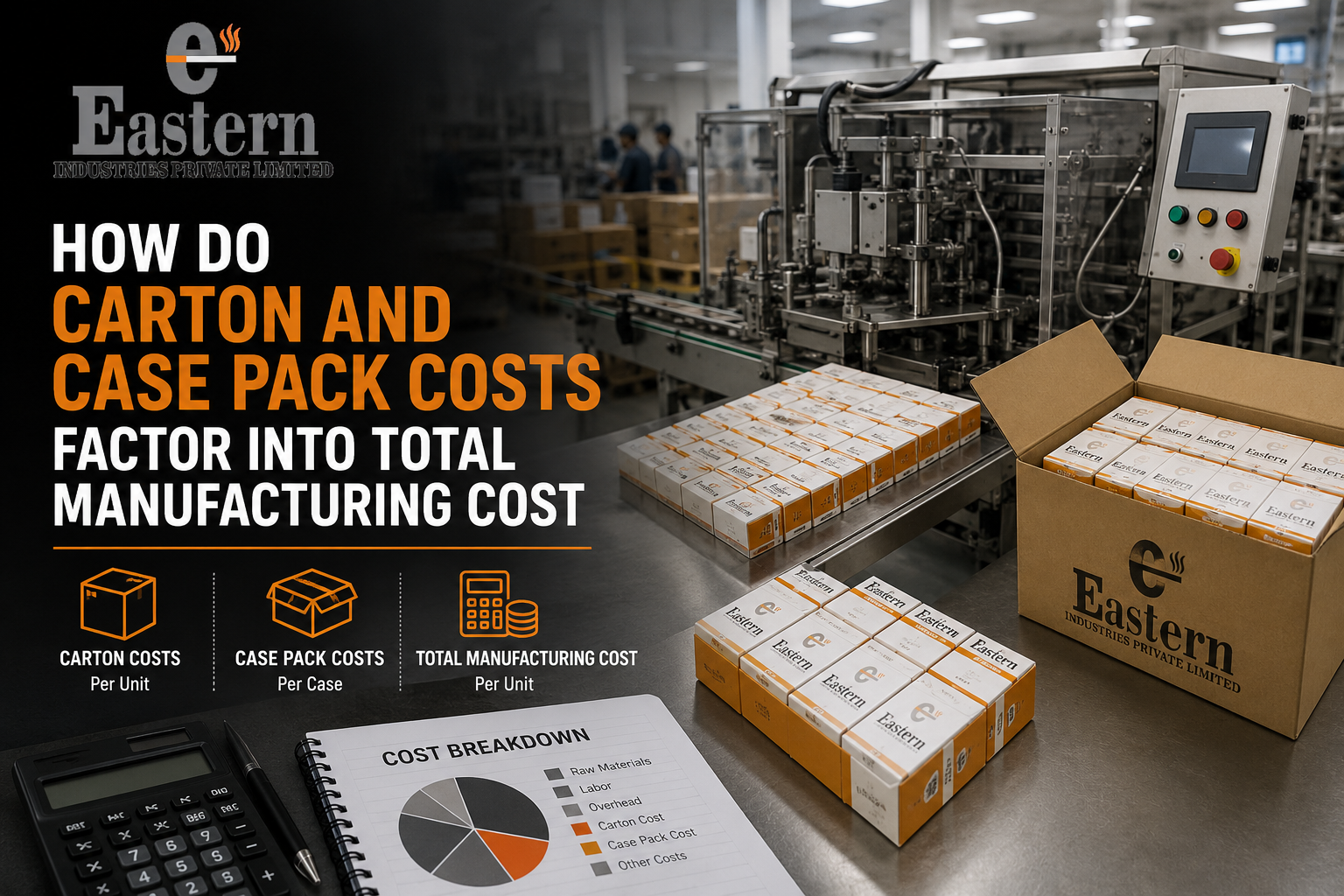
How Do Carton and Case Pack Costs Factor Into Total Manufacturing Cost
When manufacturers calculate the true cost of producing a cigarette carton, the conversation almost always starts with tobacco, paper, and filters. But packaging economics run far deeper than the primary pack. Carton construction, case packing, and the labor and materials tied to both often account for a larger share of total manufacturing cost than most production teams expect. For brands trying to control margins, understanding this layered cost structure isn’t optional. It’s foundational to pricing, forecasting, and supplier negotiations.
This becomes especially clear once you separate primary packaging (the pack itself) from secondary packaging (the carton) and tertiary packaging (the shipping case). Each layer carries its own material costs, labor requirements, and compliance obligations, and each one compounds the next. A brand that treats packaging as an afterthought during budgeting is almost guaranteed to see cost overruns once production scales.
Understanding the Cigarette Carton: More Than Just a Container
A cigarette carton isn’t just a box that holds ten packs together. It’s a compliance vehicle, a branding surface, and a logistics unit all at once. Regulatory bodies require specific labeling, health warnings, and tax stamps to be printed directly on the carton, which means every carton must meet exact specifications before it ever reaches a retail shelf. This adds a layer of precision, and cost, that generic consumer packaging doesn’t carry.
Beyond compliance, the carton also protects the integrity of the packs inside during transport and handling. Board weight, coating, and structural design all influence how well a carton withstands the supply chain. Manufacturers who underinvest in carton quality often see it show up later as damaged returns or retailer rejections, which ultimately costs more than paying for the right material upfront.
Carton Packaging Cost Breakdown: What Goes Into the Price
A complete carton packaging cost breakdown typically includes several line items: paperboard or corrugated stock, ink and print setup, regulatory labeling, tooling for die-cuts, and the labor or machine time required for folding and assembly. Premium finishes such as foil stamping, embossing, or specialty coatings add further cost but are often used strategically to differentiate a brand on crowded retail shelves.
Order volume plays a significant role as well. Smaller production runs carry higher per-unit costs because setup and tooling expenses are spread across fewer units. Larger runs benefit from economies of scale, but they also require manufacturers to commit more capital upfront and manage more inventory risk. Getting this balance right is one of the more overlooked skills in cost-conscious cigarette production planning, and it’s a conversation that should happen early, well before a production line is finalized.
What Is Case Pack Cost and Why It Matters
While the carton groups individual packs together, the case pack groups multiple cartons for shipping and warehousing. This is where case pack cost cigarettes manufacturers deal with becomes a distinct budget line rather than a rounding error. Case packing involves corrugated shipping boxes, palletization materials, and often automated case-packing machinery that adds both capital and operational cost to a production line.
Case pack cost is frequently underestimated because it sits downstream of the more visible primary and secondary packaging stages. Yet it directly affects freight pricing, since dimensional weight and case density influence shipping rates. A poorly designed case pack can inflate logistics costs even when the carton and pack themselves are efficiently produced, which is why case pack specifications deserve the same scrutiny as the carton design itself.
Secondary Packaging Cost in Manufacturing: The Hidden Multiplier
Industry data consistently shows that packaging can represent anywhere from 10% to 40% of a product’s overall retail price, and secondary packaging is often where costs quietly accumulate. Secondary packaging cost manufacturing teams budget for isn’t limited to materials. It includes machinery depreciation, changeover time between SKUs, and the labor needed to manage multiple case configurations for different retail partners.
Retailers themselves add complexity here. Large chains frequently specify their own case pack requirements, including weight limits, dimensions, corrugate strength, and even scan-ability from multiple angles, and manufacturers producing for several retail channels must accommodate these variations without letting costs spiral. This is one reason standardization, wherever regulations allow it, tends to be one of the most effective cost-control levers available to manufacturers operating at scale.
How Carton and Case Pack Costs Combine Into Total Manufacturing Cost
When these costs are added together (primary pack, carton, and case) the cumulative effect on total manufacturing cost becomes clear. Packaging is rarely a single line item; it’s a stack of interdependent costs that grows with every additional layer of protection, compliance, and branding. A manufacturer calculating true unit economics needs to account for materials, labor, tooling amortization, printing, freight impact, and expected damage rates across all three packaging tiers.
This is also where production timing matters. Packaging decisions made early in development influence machinery selection, line speed, and changeover flexibility much later in production. Brands exploring how these stages connect often find it useful to review a full Cigarette Manufacturing Timeline: From Tobacco Sourcing to Final Pack, which shows exactly where carton and case pack decisions intersect with sourcing, blending, and final assembly.
Key Factors That Influence Case Pack Cost for Cigarettes
Several variables consistently drive case pack costs up or down. Order volume remains the biggest factor, since higher volumes spread fixed costs across more units. Material selection is next, since heavier or higher-grade corrugate costs more but reduces damage-related losses. Regulatory requirements around labeling and tax compliance add printing and verification costs that vary by market. Finally, logistics considerations, including how case dimensions affect palletization and freight efficiency, can meaningfully shift total cost even when material choices stay the same.
Manufacturers who model these variables together, rather than in isolation, typically arrive at more accurate cost forecasts and avoid the budget surprises that come from treating packaging stages as separate line items.
Strategies to Optimize Carton and Case Pack Costs Without Compromising Quality
Cost optimization doesn’t have to mean cutting corners. Standardizing case dimensions across product lines reduces tooling and changeover costs. Negotiating volume-based pricing with paperboard and corrugate suppliers can meaningfully lower per-unit material costs. Investing in flexible, servo-driven case-packing machinery reduces changeover time when running multiple SKUs, which pays for itself over sustained production volume. Finally, working closely with packaging suppliers early in the design process, rather than after specifications are finalized, consistently produces better pricing and fewer costly revisions.
Why Partnering With the Right Manufacturer Makes a Difference
Given how tightly carton design, case packing, and compliance requirements are interconnected, many brands find that managing all of this in-house isn’t the most cost-effective path. Partnering with an experienced Contract Manufacturing provider gives brands access to established supplier relationships, calibrated machinery, and packaging expertise that would otherwise take years and significant capital to build internally. This is particularly valuable for brands entering new markets or scaling production, where packaging missteps can be costly and difficult to reverse.
Conclusion
Carton and case pack costs are not peripheral expenses tacked onto cigarette manufacturing. They are structural components of total production cost that influence pricing, logistics, and brand positioning. From the compliance-driven design of the cigarette carton to the freight implications of case pack decisions, every layer adds measurable cost that deserves careful planning rather than reactive budgeting. Manufacturers who map these costs accurately, and who understand how they connect to broader production stages, are far better positioned to protect margins and scale sustainably.