
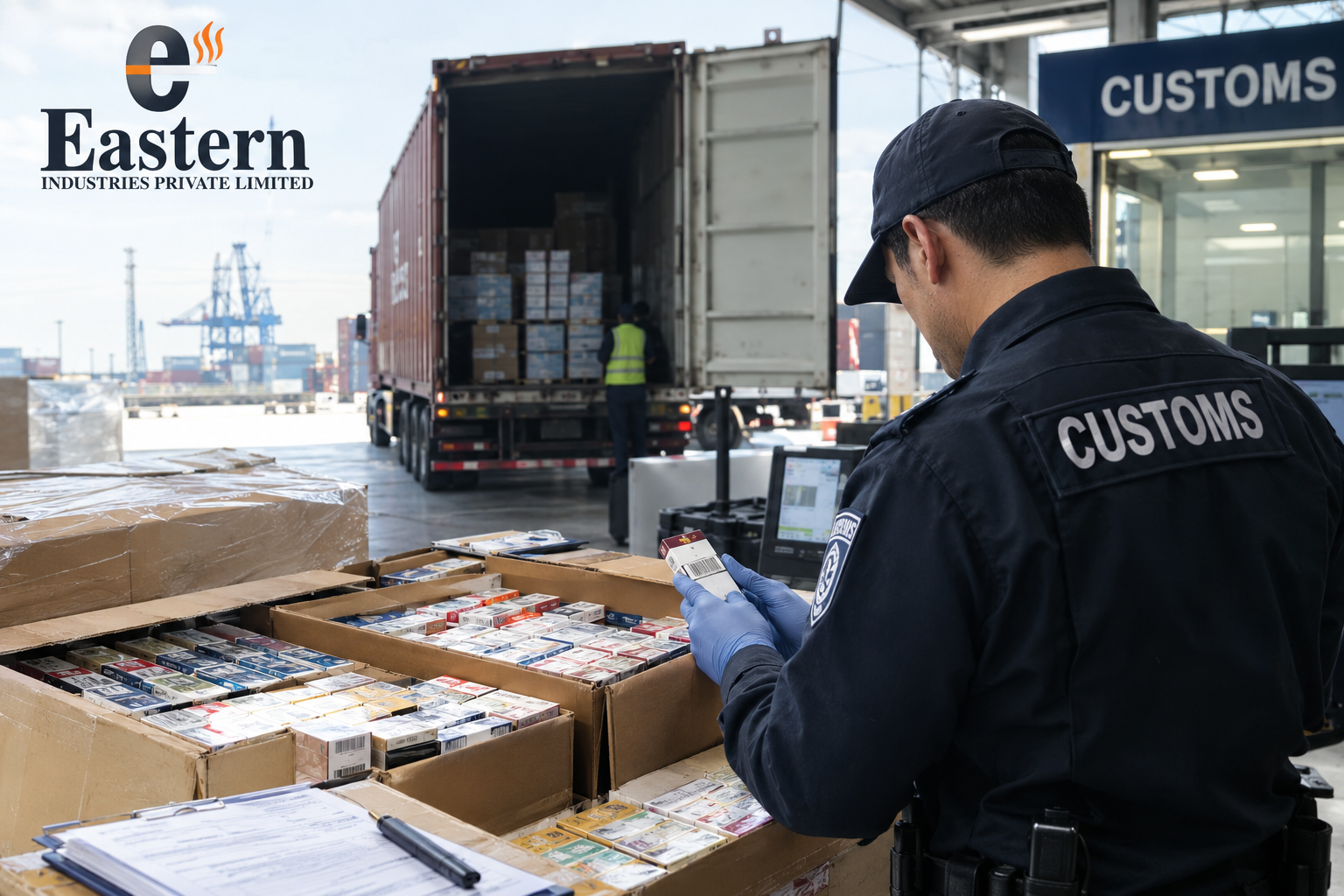
What Are the Most Common Reasons a Cigarette Shipment Gets Held at Customs?
Few cargo categories attract as much scrutiny as tobacco. A container of cigarettes carries far more duty and excise liability than most goods of equivalent volume, which means customs authorities treat it as a revenue priority rather than routine freight. For exporters and importers, the practical consequence is simple: small errors that would pass unnoticed on other cargo will stop a tobacco consignment at the border. Detained consignments and pre shipment compliance reviews are handled directly by our trade compliance team, Contact Us to discuss your lane. This guide sets out the cigarette shipment held at customs reasons that appear most frequently, so you can design them out of your process before the container sails.
Why Tobacco Consignments Face Heavier Scrutiny
Chapter 24 of the tariff attracts heavy excise duty in every destination market. That single fact shapes everything that follows. Authorities build intelligence programmes around tobacco, share information with counterpart agencies abroad, and act on tip offs well before a vessel arrives.
The typical sequence is worth understanding. Customs issues a pre lodgement control order or an alert order based on intelligence, which triggers a full physical examination of the container rather than a documentary check. If the examination reveals a discrepancy, a warrant of seizure and detention follows. By that stage the matter has moved from a clearance problem to an enforcement case, and the cost and timeline change completely.
This is why prevention matters far more than remedy in tobacco logistics. Once a hold escalates, resolution is rarely quick.
Misdeclaration and Documentation Errors
Misdeclaration is the single largest category of enforcement action, and the case record shows how blatant some of it is. Containers have been seized after being declared as packaging material, plastic cups, disposable diapers, handicrafts and even electrical generators, only for physical examination to reveal cigarettes.
Legitimate traders rarely misdeclare deliberately. They get caught by inconsistency instead. The commercial invoice says one brand variant, the packing list says another. The bill of lading shows a different gross weight. The certificate of origin names a manufacturer that does not appear anywhere else in the file. Customs reads these mismatches as risk indicators regardless of intent.
Another avoidable failure is incomplete marking. Shipments have been detained simply because the packages did not bear the name and address of the consignee. Check every document against the physical cargo before loading, not after a hold notice arrives.
Missing Licences, Permits and Clearance Certificates
Tobacco moves under a licensing layer that sits above ordinary import and export permissions, and missing a single document is enough to stop everything.
Seizures have followed from the absence of a national tobacco authority permit and from failure to obtain the required export clearance certificate. In one documented case, a consignee was given fifteen days to produce the paperwork needed to claim the cargo, could not do so, and lost the shipment to seizure.
Permits also expire, and they are frequently tied to specific quantities, destinations or validity windows. A permit that covered your last consignment may not cover this one. Exporters working from Pakistan will find this guide on How to Export Cigarettes from Pakistan: Licences, Documents and Logistics Step by Step useful for mapping the full documentation chain before booking space.
Tax Stamps and Track and Trace Failures
This is now one of the most common customs hold reasons tobacco shippers encounter, and it is almost entirely preventable.
In the UAE, importing cigarettes that do not bear Digital Tax Stamps is prohibited. The scheme operates under Cabinet Decision No. 42 of 2018, with phase one banning the sale or possession of unmarked cigarettes across local markets from 1 August 2019, and phase two extending the requirement to waterpipe tobacco and electrically heated cigarette plugs from 1 March 2020. Critically, the stamps must be applied before importation, in the position and manner the Federal Tax Authority specifies. Arriving at the port and arranging stamps afterwards is not an option.
In the European Union, the Tobacco Products Directive requires an irremovable unique identifier on every unit packet plus a tamper proof security feature, with the cigarette and roll your own deadline set at 20 May 2019. The WHO FCTC Protocol additionally requires that unique identification markings be secure.
A Barcelona seizure of nearly half a million packs rested on exactly this point. The packs lacked the regulatory seals, and the documentation proving legal importation was absent.
Classification and Valuation Disputes
Cigarettes containing tobacco fall under HS subheading 2402.20, but national tariff schedules subdivide that into eight to ten digit lines where the actual duty rates attach. Those national lines differ by country, which is where disputes begin. The 2022 HS update created heading 2404 specifically for heated tobacco and vape products, and classification arguments in that area remain active.
Valuation is the second battleground. Authorities routinely compare declared values against contemporaneous import data and published valuation rulings. Where the declared figure sits materially below the benchmark, they re value the goods, confirm a revised duty demand and impose penalties.
Tribunal practice does draw a line between a genuine difference of interpretation on an HS code and deliberate misdeclaration, but that distinction only protects you if your reasoning is documented. Keep the technical specification, the classification rationale and the pricing basis on file, and consider requesting a binding ruling from the destination authority for recurring shipments.
Market Restriction Markings and Origin Rules
Packaging intended for one market frequently cannot legally enter another. Shipments carrying “For Domestic Sale Only” markings have been seized for breaching export prohibitions, which catches out businesses attempting to move surplus domestic stock into export channels.
Country of origin marking is a parallel requirement. Each package is generally required to be marked to show the country of origin, and omissions give customs a straightforward basis for detention.
Health warning compliance belongs in the same category. The EU TPD requires pictorial and text health warnings covering 65% of the pack surface, while other jurisdictions set their own size, language and placement rules. Enforcement agencies have issued seizure warrants citing graphic health warning legislation alongside customs offences. Artwork must be approved against the destination market’s rules before the production run, because a non compliant print run cannot be fixed at the port.
Intellectual Property and Counterfeit Suspicion
Brand owners cooperate closely with customs, and their representatives are often present when suspect cargo is examined. Seizures have proceeded under intellectual property legislation where the goods were suspected counterfeits, with the consignments then destroyed under agreements between authorities and manufacturers.
Even legitimate traders get caught here when documentation does not clearly establish authorised supply. If you are moving branded product, carry the authorisation chain in the shipping file: manufacturer declaration, distribution agreement and any brand owner consent for the specific market. The absence of that evidence invites suspicion that is slow and expensive to rebut.
What a Hold Actually Costs
Understanding why cigarette shipments get stuck is only half the picture. The financial impact compounds quickly through demurrage and container detention, storage fees, surveyor and laboratory costs, legal representation and the working capital tied up in goods you cannot sell.
There is also the regulatory tail. An enforcement case creates a compliance record that raises your risk profile, which means future consignments face a higher inspection rate. One mishandled shipment can slow your entire lane for years.
A Practical Pre Shipment Checklist
Avoiding shipment delays comes down to discipline applied before loading rather than reaction afterwards.
Verify that the HS code matches the destination’s national tariff line and document the reasoning. Reconcile invoice, packing list, bill of lading and certificate of origin line by line against the physical cargo. Confirm every licence and permit is valid for this quantity, this destination and this date range. Confirm tax stamps or unique identifiers are applied before shipment in the exact format the destination requires. Check health warning artwork, pack size and language against current destination rules. Confirm the goods carry no market restriction markings and are correctly marked with country of origin. Keep the brand authorisation chain in the file.
Experienced exporters such as Eastern Tobacco generally run this verification as a formal sign off before booking space, rather than treating it as a freight forwarder’s responsibility.
Final Thoughts
Almost every customs hold on tobacco traces back to something that was knowable before the container left. Classification, documentation, licensing, fiscal marking and labelling are all verifiable in advance. Build that verification into your shipping process as a required step, keep the evidence on file, and the overwhelming majority of holds simply stop happening.