
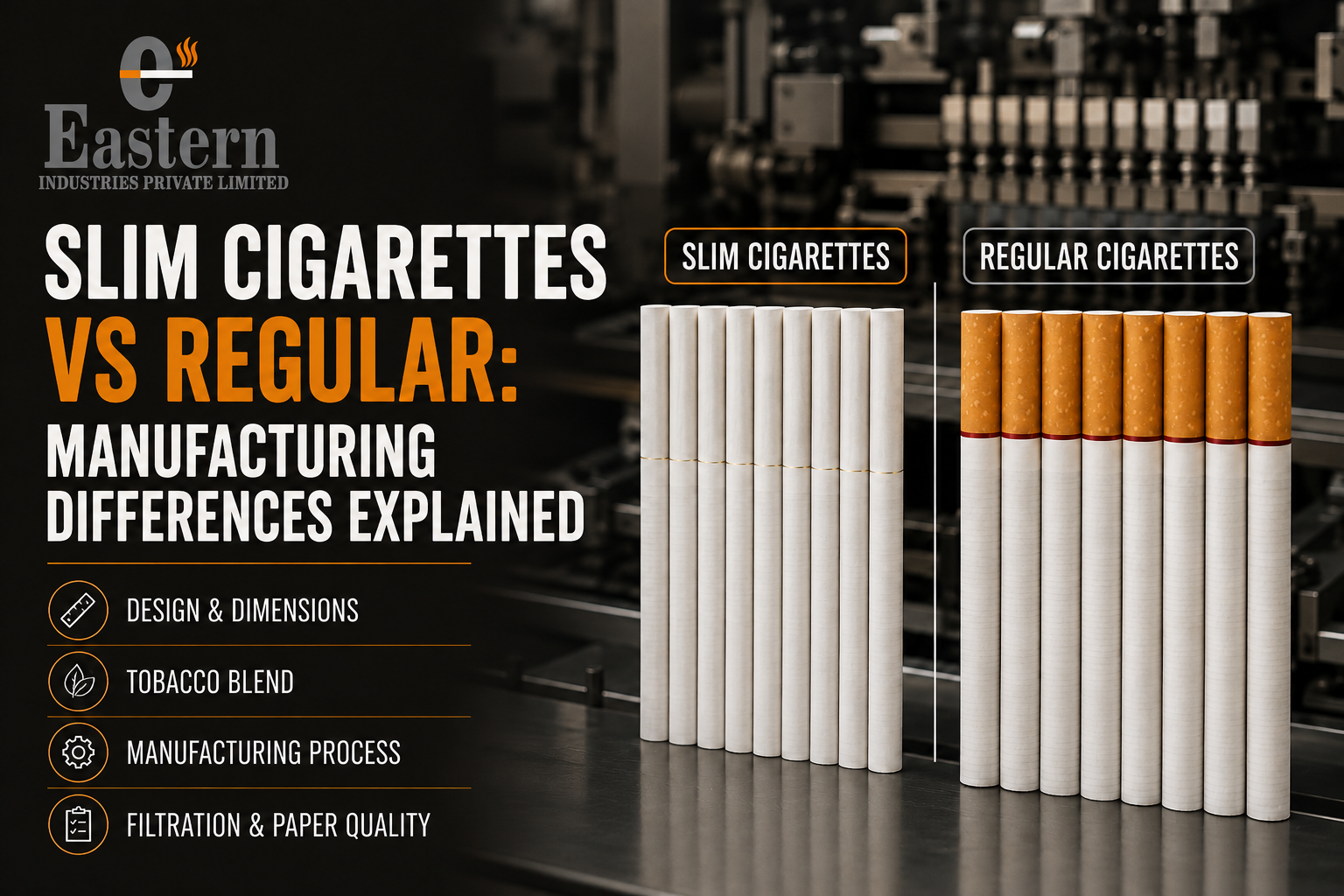
Slim Cigarettes vs Regular: Manufacturing Differences Explained
From the outside a slim cigarette and a regular one look like the same product in a narrower format. Pick them both up and the difference is obvious. But what most people never think about is how differently these two formats are actually made. The machinery is different. The cut specification is different. The filter engineering is different. The packaging line is different. Slim cigarettes manufacturing is not simply regular cigarette production scaled down. It is a distinct process with its own tolerances, its own challenges, and its own set of things that can go wrong if the production setup is not built specifically for the format. This piece explains where those differences actually live.
The Dimensional Gap and Why It Matters
Start with the numbers. A standard king size cigarette dimensions run at approximately 84 millimetres in length with a circumference of around 24 to 25 millimetres, giving a diameter of roughly 7.8 to 8 millimetres. A slim cigarette typically sits at the same length or slightly shorter but with a circumference of around 17 millimetres and a diameter closer to 5.4 millimetres. A super slim format goes narrower still, dropping to circumferences of 14 to 15 millimetres in some configurations.
That dimensional gap changes almost everything downstream. The tobacco rod has to be formed at a smaller diameter, which requires tighter tolerances on the making machine. The paper wrap has to seal cleanly around a smaller circumference, which is more technically demanding than wrapping a standard rod. The filter has to deliver the right pressure drop and filtration performance in a smaller cross-sectional area, which requires a different tow specification than a regular format filter would use. None of these adjustments are trivial and all of them affect the consistency of the finished product if any one of them is off.
How the Making Machine Differs for Slim Formats
A cigarette making machine forms a continuous tobacco rod, wraps it in paper, and cuts it to length at high speed. For regular formats this process runs on equipment that has been refined over decades to handle a well-understood set of parameters. Slim and super slim formats require machines that are either purpose-built for narrower rod diameters or extensively reconfigured from standard equipment, and that reconfiguration is not a minor adjustment.
The tobacco feed mechanism has to deliver a consistent volume of cut tobacco into a narrower forming channel. Any variation in feed density creates a rod that is uneven along its length, which shows up as an inconsistent draw and uneven burn in the finished cigarette. The paper tension has to be managed more precisely on a slim format because there is less overlap in the seam, and a seam that opens during smoking on a slim cigarette is more visible and more disruptive to the smoking experience than the same defect on a regular format.
Speed is also affected. Most slim format making machines run at lower speeds than their regular format equivalents because the tolerances involved leave less margin for error at higher production rates. This is one of the reasons slim cigarettes manufacturing costs more per unit than regular format production even when the tobacco fill weight per cigarette is lower.
Tobacco Cut Specification for Slim vs Regular
The cut width of the tobacco has a direct relationship with the rod diameter it is being filled into. A coarser cut that works well in a regular format cigarette will not pack evenly into a slim format rod. The individual strands of tobacco are too wide relative to the internal diameter of the tube, which creates air pockets, uneven density, and a burn that runs down one side of the cigarette faster than the other.
Slim format production requires a finer cut, typically in the range of 0.6 to 0.8 millimetres compared to the 0.8 to 1.0 millimetre range commonly used for regular formats. That finer cut produces a more uniform pack density inside the narrower rod and a more consistent burn profile across the length of the cigarette. It also places higher demands on the cutting machinery because maintaining a fine cut specification consistently across a large production run requires more frequent blade maintenance and tighter process monitoring than a standard cut.
Filter Engineering for Slim Formats
The filter is where the difference slim vs regular cigarette becomes most technically involved. A regular format filter has enough cross-sectional area to achieve the target pressure drop using a relatively straightforward acetate tow configuration. A slim format filter has to achieve a comparable pressure drop in a significantly smaller diameter, which requires a higher tow density or a different tow denier specification to compensate for the reduced surface area available for filtration.
Getting the pressure drop wrong on a slim cigarette is more noticeable than on a regular format because the smoker is already working with a narrower draw. A filter that is too restrictive on a slim cigarette feels genuinely uncomfortable. One that is too open makes the cigarette feel insubstantial. The tolerance window for an acceptable slim format filter is narrower than for a regular format, which is why filter specification deserves dedicated attention in the slim cigarette format product development process rather than being treated as a straightforward scaling of the regular format specification.
Packaging Line Differences
The differences do not stop at the cigarette itself. Slim format cigarettes require different packaging configurations than regular formats. The pack dimensions change, the foil wrapping must accommodate a different stick diameter, and the carton geometry adjusts to fit the slimmer pack profile. A packaging line configured for king size hard packs cannot simply run slim packs without reconfiguration, and that reconfiguration adds setup time and cost to every production run.
For brands launching in both regular and slim formats simultaneously, this packaging line difference means either running two separate production schedules or absorbing the changeover time between formats within a single run. Neither option is free and both need to be factored into the overall cigarette production process planning before the first order is placed.
What This Means for Brands Choosing a Format
The cigarette size comparison between slim and regular is not just a consumer preference question. It is a production and commercial decision that affects unit cost, minimum order thresholds, lead times, and the technical capability requirements for the manufacturer. Brands that choose slim formats because they look premium without understanding the manufacturing implications sometimes find that the economics of slim production do not match their initial cost assumptions.
That does not mean slim is the wrong choice. In many markets slim formats command a price premium that more than offsets the higher production cost per unit. The key is making the format decision with a clear understanding of both the consumer positioning and the production reality rather than treating them as separate conversations. A manufacturer with genuine experience in both formats can give that picture clearly before the commitment is made rather than after the first production run reveals the complications.
Eastern Tobacco produces both regular and slim format cigarettes across its premium quality cigarettes range, with production infrastructure built specifically for each format rather than adapted from a single standard line. For brands that want a format matched to their market positioning without absorbing the trial and error of working with a manufacturer whose slim format capability is an afterthought, that production separation matters. The full scope of format options and production capabilities available to new and established brands is covered under custom cigarette manufacturing services.
Conclusion
Slim and regular cigarettes look like variations of the same product. In manufacturing terms they are genuinely different propositions. The making machine setup, the tobacco cut, the filter specification, the packaging line, all of it changes when the diameter changes, and none of those changes are trivial. Brands that understand the slim cigarettes manufacturing differences before choosing a format make better decisions about pricing, minimum orders, and supplier selection. The ones that discover the differences after committing to a format tend to find out the hard way that a narrower cigarette involves considerably more complexity than the name suggests.